Part I: Defining the Social Business Landscape
Section 1: Core Principles and Defining Characteristics
The concept of social business represents a fundamental rethinking of the purpose of commerce, positioning it as a direct tool for solving humanity’s most pressing problems. Born from a critique of both profit-maximizing capitalism and donation-dependent charity, the social business model seeks to occupy a unique space: a sustainable, market-driven enterprise whose primary objective is social good, not private wealth accumulation.1 Its definition has evolved from a set of strict, foundational principles laid down by its pioneers to a more dynamic, evidence-based framework demanded by a maturing sector.
The Yunus Doctrine: The Seven Foundational Principles
The most prominent and rigorous definition of social business was articulated by Nobel Peace Prize laureate Professor Muhammad Yunus, the founder of Grameen Bank.2 He conceives of a social business as a non-dividend company created and designed exclusively to address a social problem.4 This model is built upon seven core principles that delineate it from all other forms of enterprise:
- Business Objective to Overcome Societal Problems: The primary and unwavering goal is to overcome poverty or one or more problems threatening people and society, such as those in education, health, technology access, and the environment. Profit maximization is explicitly rejected as the core objective.6
- Financial and Economic Sustainability: The enterprise must be financially self-sustaining. It is a business, not a charity, and must generate sufficient revenue to cover all its costs without incurring losses.4
- Investment Return Only: Investors recoup only their original investment amount. No dividend or profit is ever paid beyond that initial sum.4 This principle is a critical and defining feature that ensures the business remains non-extractive.
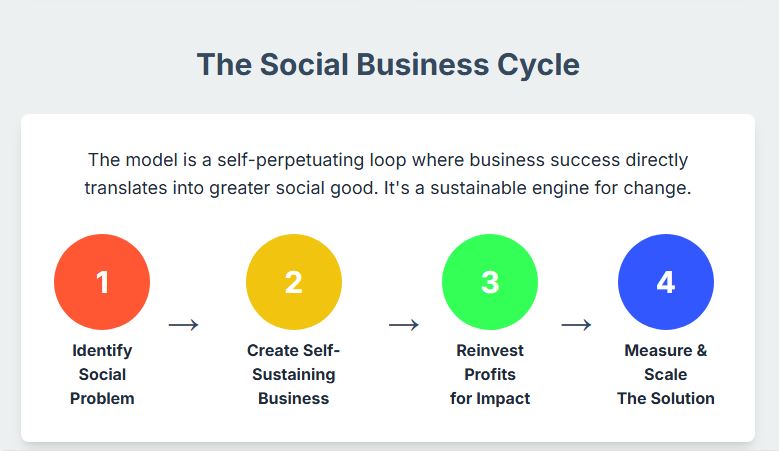
- Profit Reinvestment for Social Impact: Once the initial investment is repaid, all profits are retained within the company. These profits are reinvested to expand the business, improve its products or services, and ultimately increase its social impact.4
- Gender and Environmental Consciousness: The business must operate in a manner that is sensitive to gender equality and is environmentally conscious, ensuring its operations do no harm and actively contribute to sustainability.4
- Fair Workforce Conditions: Employees are to be paid a market wage and provided with working conditions that are better than standard industry practices.4
- Joy in the Work: The final principle emphasizes that the endeavor should be carried out with joy, reflecting the passion and purpose behind the mission.4
An Evolving Paradigm: Beyond Belief to Evidence
While the Yunus doctrine provides a clear and powerful foundation, the contemporary social business landscape is evolving. As the sector grapples with increasingly complex global issues and attracts more sophisticated stakeholders, a new set of guiding principles has emerged, championed by institutions like the 100x Impact Accelerator.1 This modern perspective argues that the traditional pillars of purpose and belief, while necessary, are no longer sufficient. It calls for a fundamental shift toward greater rigor and accountability.
This evolution is not merely a semantic adjustment but reflects a crucial maturation of the social business sector. The initial wave of social entrepreneurship, driven by the powerful moral vision of pioneers like Yunus, was essential for establishing the concept.3 However, as the field has grown, it has attracted the attention of a more discerning impact investment market and faced scrutiny over its effectiveness. This has created a demand for verifiable proof of impact, not just compelling narratives of intent.10 Concurrently, the popularization of “social” as a business descriptor has led to valid concerns about “social washing,” where corporations claim social benefits without substantive action.12 In response, the sector is professionalizing, demanding the same level of analytical rigor for social outcomes that traditional businesses apply to financial performance.
This new framework emphasizes three key shifts 1:
- From Purpose to Clarity: It is no longer enough to have the broad purpose of “making the world better.” A modern social business must have absolute clarity on the specific problem it is solving, the precise population it is helping, the mechanics of its intervention, and how it will measure its effect. Founders are pressed to answer fundamental questions: What problem are you solving? Who are you helping? How are you doing it differently or better?.1
- From Scale to Impact: The focus shifts from organizational growth to the quality and depth of the change created. In a for-profit business, growth and scale are straightforward metrics. In a social business, the true measure of success is the tangible, positive change in people’s lives and communities. This requires prioritizing the quality of impact over the size of the organization and placing the client at the center of all scaling decisions.1
- From Belief to Evidence: Passion and conviction are the catalysts for any social venture, but they must be substantiated with data. Evidence-based, data-driven decision-making is now considered the bedrock of effective social initiatives. Collecting and analyzing data allows a social business to understand the real-world effects of its work, identify areas for improvement, and demonstrate its value to supporters and investors. This shift enhances credibility and ensures that efforts are truly making a difference, moving beyond simply believing in a mission to proving its effectiveness.1
Synthesized Characteristics of a Modern Social Business
Synthesizing these foundational and evolving principles, a modern social business can be defined by a set of core characteristics that guide its strategy and operations:
- A Primary Social Mission: The enterprise has a clear social or environmental mission that is not an afterthought but the very reason for its existence. This mission is deeply integrated into all business activities, from product design to supply chain management.4
- Financial Self-Sufficiency: The business model is designed to generate enough revenue through the sale of goods or services to cover its costs and fund its growth. This operational independence distinguishes it from traditional charities, which are reliant on a continuous cycle of fundraising and donations.2
- Innovation and Collaboration: There is a persistent drive to find creative, disruptive, and more effective solutions to social challenges. This often involves collaborating with other organizations—including NGOs, governments, and even other businesses—to leverage collective expertise and maximize impact.4
- Transparency and Accountability: A commitment to being transparent about both financial performance and social impact is paramount. This includes publishing reports that track progress against the stated social mission and being accountable to all stakeholders, especially the communities being served.4
- Triple Impact Focus: The ultimate goal is to generate a positive “triple impact” by creating measurable social, environmental, and economic value. This holistic approach places people and the planet on equal footing with profit, seeking to balance the well-being of all three.13
Section 2: The Genesis and Evolution of the Social Business Movement
While the term “social business” gained prominence in the late 20th century, the underlying principle of using enterprise for social betterment has deep historical roots. The movement’s evolution can be traced through several distinct eras, each shaped by prevailing social, economic, and political forces, culminating in the global phenomenon seen today.
Precursors and Early Roots
The idea that business could serve a purpose beyond profit is not a modern invention. Its intellectual and practical lineage can be traced back centuries:
- Early Industrial Reform: During the Industrial Revolution, social reformers like Robert Owen, a Welsh textile manufacturer, implemented revolutionary concepts in his enterprises, including improved living and working conditions for his employees and the establishment of cooperative societies. These initiatives were early demonstrations of embedding social reform within a commercial entity.17
- Philosophical Foundations: In the 16th century, the Spanish scholar Juan Luis Vives argued in his essay On Relief of the Poor that civil authorities had a responsibility to provide for the poor, marking a philosophical shift toward recognizing and strategizing against social inequality.18
- The Cooperative Movement: The Rochdale Society of Equitable Pioneers, formed in England in 1844, is often cited as the first social enterprise resembling a modern structure. The “Rochdale Principles” they established for the operation of cooperatives are still used as a benchmark today and had a major influence on the development of social innovation.18
- Early American Examples: In the United States, organizations like Goodwill Industries, founded by Edgar J. Helms in 1902, were created with the explicit mission of providing job opportunities for individuals facing barriers to employment, such as those with disabilities or criminal records.19
The Mid-20th Century Catalyst: Social Movements and Emerging Thought
The social and political ferment of the mid-20th century created fertile ground for the formalization of the social business movement. The widespread questioning of traditional institutions and the rise of social activism inspired new models for change:
- Influence of Social Movements: The Civil Rights Movement in the United States inspired organizations dedicated to addressing racial inequality and social justice. Similarly, the environmental movement of the 1960s and 1970s led to the creation of eco-friendly businesses, while the women’s rights movement prompted enterprises focused on gender equality and empowerment.19
- Cause-Related Marketing: A significant precursor emerged in the business world in the 1980s with “cause-related marketing.” The 1983 campaign by American Express, which pledged donations to the Statue of Liberty restoration fund for every new card and transaction, was a landmark event. It proved that aligning a commercial brand with a social cause could be a powerful tool for increasing customer loyalty and revenue, demonstrating a market-based logic for social action.20
The Formalization of a Movement (Late 20th Century)
This period marked the point where “social entrepreneurship” and “social business” were formally conceptualized and institutionalized by visionary leaders who provided the movement with its modern intellectual architecture.
- Bill Drayton and Ashoka: The founding of Ashoka: Innovators for the Public in 1972 by Bill Drayton was a pivotal moment. Drayton is credited with coining and popularizing the term “social entrepreneur” and created the first global network dedicated to identifying, funding, and supporting these “changemakers.” By providing a platform and resources, Ashoka professionalized the field and gave it a distinct identity.18
- Muhammad Yunus and Grameen Bank: The most powerful and enduring blueprint for a modern social business came from the work of Muhammad Yunus in Bangladesh. His journey began with a simple act in 1974 during a famine: a personal loan of $27 to 42 families so they could create items for sale without falling prey to predatory lenders.23 This small experiment grew into a formal research project and culminated in the establishment of Grameen Bank in 1983.3 Yunus’s revolutionary model of providing microcredit to the poor—primarily women—without requiring any collateral demonstrated that a business could be financially sustainable, scalable, and a potent force for poverty alleviation. Grameen Bank became the archetypal social business, proving that the poor were bankable and that a business could be designed to serve humanity, not just to generate profit.8
The 21st Century: Globalization, Technology, and Diversification
In the 21st century, the social business movement has expanded into a global force, driven by several key factors:
- Technological Acceleration: The advent of the internet, mobile technology, and digital platforms has been a powerful enabler. Technology has democratized access to capital through crowdfunding platforms like Kiva, enhanced the scalability and reach of social ventures, and facilitated global collaboration and knowledge sharing among entrepreneurs.17
- Global Diversification: The movement has diversified far beyond its initial focus on microfinance. Social businesses now address a vast array of issues, including environmental sustainability (e.g., SELCO in India, which provides sustainable energy solutions), financial accessibility (e.g., M-Pesa in Africa, which transformed mobile payments), healthcare, and education.17
- Mainstream Recognition: The concept has entered the mainstream of business and policy discourse. Major institutions like the Organisation for Economic Co-operation and Development (OECD) and the European Commission have developed reports, action plans, and guidelines to support the growth of the social economy, signaling its recognition as a legitimate and important sector.12
The history of social business reveals a consistent theme: it emerges to fill the voids left by the state and the traditional market.1 This reactive origin is both its greatest strength and the source of its most profound challenges. From Jane Addams’ Hull House addressing urban poverty in the 19th century to Grameen Bank serving the “unbankable,” social businesses have consistently arisen in response to unmet needs.19 This pattern of “filling the gap” means that social businesses inherently operate in the most difficult environments—serving marginalized customers, navigating inadequate infrastructure, and compensating for weak legal or financial systems, often referred to as “institutional voids”.28 The very reason for a social business’s existence is thus inextricably linked to its primary operational hurdles. The mission to serve the underserved forces it to confront complex value chains and a lack of supporting institutions, reframing these challenges not as mere obstacles but as intrinsic, predictable features of the model that must be strategically addressed from the outset.
Section 3: A Comparative Analysis: Delineating the Social Business Model
To fully grasp the unique identity of a social business, it is essential to delineate it from other organizational forms that also engage in social value creation. The landscape is often crowded with confusing and overlapping terms. A rigorous comparative analysis against traditional for-profit companies, non-profit organizations (NGOs), corporate social responsibility (CSR) initiatives, and the closely related concept of “social enterprise” reveals the distinct DNA of the social business model.
Social Business vs. Traditional For-Profit Companies
The most fundamental distinction lies in the core purpose of the organization.
- Primary Objective: A traditional for-profit company exists to maximize profit for its shareholders. This is its primary, legally mandated objective.4 A social business, while needing to be financially viable, has a primary objective of solving a social or environmental problem. Profit is a means to achieve and scale this social mission, not the end goal itself.30
- Profit Distribution: In a traditional company, profits are distributed to shareholders in the form of dividends.4 In a pure social business, following the Yunus model, investors only recoup their initial investment. All profits are perpetually reinvested back into the business to expand its social impact.4
- Success Metrics: Success for a traditional business is measured by financial metrics: revenue growth, profit margins, market share, and return on investment (ROI).16 A social business measures success using a “triple bottom line” of People, Planet, and Profit, or through specific impact metrics such as the number of lives improved, tons of carbon emissions reduced, or demonstrable progress against its social mission.13
Social Business vs. Non-Profit Organizations (NGOs)
While both are mission-driven, their engines of sustainability are fundamentally different.
- Financial Model: A traditional non-profit or NGO is primarily reliant on external, philanthropic funding sources such as donations, grants, and government subsidies. Its survival depends on a continuous cycle of fundraising.33 A social business, in contrast, is designed to be financially self-sufficient. It generates its own revenue through the sale of goods or services in the marketplace, creating a sustainable financial model that is not dependent on charitable giving.35
- Operational Mindset: This financial difference fosters a different operational mindset. NGOs typically operate with a programmatic, service-delivery focus, managing grants and reporting to donors. A social business adopts a market-driven, entrepreneurial approach, focusing on customer needs, competitive positioning, and operational efficiency to ensure its long-term viability.33
- Tax Status: NGOs are generally structured as tax-exempt entities, and donations to them are often tax-deductible.34 A social business can take various legal forms, including for-profit structures. Even if organized as a non-profit, its earned revenue activities may be subject to unrelated business income tax (UBIT).37
Social Business vs. Corporate Social Responsibility (CSR)
This comparison hinges on the integration and primacy of the social mission.
- Core Integration: For a social business, the social mission is the business. It is the reason for its existence and is woven into the very fabric of its strategy, operations, and value proposition.38 CSR, on the other hand, is typically an initiative, department, or program
within a traditional profit-maximizing corporation. It is often a secondary activity designed to mitigate negative impacts, enhance brand reputation, or meet stakeholder expectations, rather than being the core purpose of the company.38 - Resource Allocation: A social business dedicates 100% of its resources and reinvests 100% of its profits toward its social mission.32 A CSR initiative is allocated a limited budget from the parent corporation’s overall profits and must often justify its existence in terms of its contribution to the primary goal of profit maximization.32
- Authenticity and Purpose: A social business is founded on a mission from its inception. A CSR program is an activity a company does, often in response to external pressure or as a marketing strategy.39 This distinction is critical for building trust with consumers and avoiding accusations of “social washing”.12
Social Business vs. Social Enterprise: A Critical Distinction
This is the most nuanced and frequently confused comparison in the field. The terms are often used interchangeably, but key pioneers and thinkers draw a sharp distinction based on the handling of profits.9
- The Yunus Definition (Strict): As previously detailed, Muhammad Yunus defines a “social business” with absolute strictness: it is a non-loss, non-dividend company created solely to solve a social problem.5 The non-dividend rule is non-negotiable. He considers it a specific, narrow subset of the broader social value landscape.
- The Broader “Social Enterprise” Term: “Social enterprise” serves as a much wider umbrella term. It can refer to any organization—whether structured as a for-profit, non-profit, or hybrid—that uses commercial strategies to achieve a social or environmental mission.4 Crucially, a social enterprise
can distribute profits to its owners or investors. Some definitions, for example, stipulate that a minimum of 51% of dividends must be reinvested to achieve social welfare, implying that up to 49% can be taken as profit.41 This flexibility allows social enterprises to attract a wider range of investment but also introduces the tension between mission and profit. - Implications of the Distinction: The ambiguity between these terms is more than a semantic debate; it has profound implications for an organization’s funding strategy, legal structure, and scalability. The strict, non-extractive “social business” model is inherently unattractive to traditional venture capital, which demands a financial return. However, its purity of mission can be highly appealing to philanthropic foundations and impact-first investors who want to ensure 100% of the generated value is recycled into the social cause.2 Conversely, the broader “social enterprise” model, by allowing for profit distribution, can access a much larger pool of capital from investors willing to accept a blended return. This can enable faster scaling but introduces the persistent risk of “mission drift,” where the need to deliver financial returns to shareholders can compromise or dilute the original social goals.37 The choice of model is therefore a foundational strategic decision that dictates a venture’s growth path and its mechanisms for safeguarding its mission.
The following table provides a clear, at-a-glance reference to distinguish between these often-confused terms, offering a visual tool for understanding the core DNA of each organizational type.
Table 1: Comparative Framework of Social Value Organizations
| Attribute | Traditional For-Profit Business | Non-Profit Organization (NGO) | Corporate Social Responsibility (CSR) | Social Enterprise (Broad Definition) | Social Business (Yunus Definition) |
| Primary Objective | Maximize shareholder profit 4 | Fulfill a social/charitable mission 33 | Enhance brand image & meet stakeholder expectations while maximizing profit 38 | Achieve a social/environmental mission using business methods 4 | Solve a specific social problem 2 |
| Profit Distribution | Distributed to shareholders as dividends 4 | All surplus must be reinvested into the mission 34 | Profits belong to the parent corporation; a portion is allocated to CSR activities 32 | Profits are primarily reinvested, but some distribution to owners/investors is possible 41 | No dividends beyond recouping initial investment; all profits are reinvested 6 |
| Primary Funding Source | Revenue from sales, equity investment, debt 29 | Donations, grants, government funding 34 | Corporate profits from the parent company 32 | Earned revenue, impact investing, grants, debt 15 | Earned revenue, impact-first investment, patient capital 2 |
| Key Success Metrics | Financial ROI, market share, revenue growth 16 | Program reach, funds raised, qualitative impact stories 44 | Brand reputation, PR value, employee engagement 40 | Blended value: “Triple Bottom Line” (People, Planet, Profit), SROI 13 | Measurable social impact (e.g., poverty reduction), financial self-sustainability 1 |
| Example from Research | Starbucks (as a traditional model) 30 | Doctors without Borders 35, Hashimukh 46 | Levi’s sustainability initiatives 38, Patagonia’s 1% donation 37 | TOMS 47, Warby Parker 47, BRAC 48 | Grameen Bank 7, Grameen Danone 49 |
Part II: Models, Operations, and Impact in Practice
Section 4: A Typology of Social Business Models
Social businesses employ a diverse array of business models to generate sustainable revenue while pursuing their social or environmental missions. These models are not arbitrary; they are strategic frameworks designed to address specific problems. The choice of model reveals the organization’s core theory of change—how it intends to convert market activities into social value. These models can be broadly categorized into client-focused, market-focused, and externally-focused approaches.50
The selection of a business model is deeply intertwined with the specific “institutional void” the social business aims to fill.28 The model is not merely a revenue strategy; it is the core intervention itself. For example, where the void is a lack of fair-wage jobs for marginalized populations, the Employment Model is the direct solution. Where the void is a lack of market access for rural artisans, the Market Intermediary Model provides the bridge. And where the void is a lack of affordable capital for the poor, the Entrepreneur Support Model (microfinance) is the remedy. This demonstrates that a social entrepreneur must first accurately diagnose the underlying systemic failure and then design a business model that directly corrects it. The success of the venture hinges on the precision of this diagnosis and the efficacy of the chosen model.
Client-Focused Models
These models generate revenue by directly serving a target beneficiary population.
- Employment Model: This model’s primary social function is to create jobs, provide skills training, and offer fair wages to individuals who face high barriers to employment, such as at-risk youth, people with disabilities, or the formerly incarcerated. The enterprise generates revenue by selling the products or services produced by these employees on the open market. This model directly tackles unemployment and underemployment within a specific community.50
- Fee-for-Service Model: This is one of the most common models, where the social enterprise charges its beneficiaries directly for the services it provides. It is prevalent in sectors like healthcare, education, and social services (e.g., museums, clinics).50 A critical variation is the
Low-Income Client Model, which specifically designs and delivers affordable products and services for the “base of the pyramid” (BoP) market. This requires innovation in cost reduction, distribution, and marketing to serve customers who cannot afford standard market rates.51 Aravind Eye Care’s paid services and Grameen Danone’s low-cost fortified yogurt are prime examples.49 - Entrepreneur Support Model: This model empowers its target population by providing them with the tools to become entrepreneurs themselves. It sells business support services, which can include access to capital (microfinance), business training, consulting, or technical support. The archetypal example is Grameen Bank, which provides micro-loans to poor women to start their own small businesses.50
Market-Focused Models
These models work to transform market dynamics to benefit marginalized producers or consumers.
- Market Intermediary Model: This model acts as a bridge, connecting small-scale producers, such as artisans or farmers, to larger, often higher-margin, markets they could not otherwise access. The social enterprise adds value by assisting with product design, quality control, branding, marketing, and distribution, then sells the products on behalf of the producers, returning a fair share of the revenue to them. BRAC’s Aarong, which connects tens of thousands of rural Bangladeshi artisans to urban and e-commerce retail channels, is a classic example.51
- Market Linkage Model: This model is a lighter-touch version of the intermediary model. Instead of buying and selling the clients’ products, it acts as a broker, facilitating trade relationships and connecting producers directly with buyers. The enterprise earns revenue through fees for this matchmaking service or by selling market information.50
- Cooperative Model: This is a membership-based organization that is democratically owned and operated by its members. The cooperative provides services that benefit the collective, such as bulk purchasing power, technical assistance, or collective bargaining to secure better prices. Fair trade coffee cooperatives and local credit unions are common examples.16
Externally-Focused & Hybrid Models
These models generate revenue primarily from the general public or external markets to fund separate or integrated social programs.
- Service Subsidization Model: This model operates a commercial venture, selling products or services to an external market, and uses the profits to cross-subsidize its social programs. The business activity and social program are often integrated. For example, a commercial law firm might use its revenue from corporate clients to fund an in-house program offering free legal aid to low-income individuals.50
- Organizational Support Model: This model is similar to service subsidization, but the revenue-generating business exists to financially support a separate, parent non-profit organization. Goodwill thrift stores are a well-known example; the retail business generates funds for the broader charitable mission of Goodwill.50
- “Buy-One, Give-One” (or One-for-One) Model: Popularized by TOMS Shoes, this model promises that for every product sold to a consumer, a similar product will be donated to a person in need.4 While highly effective for marketing and creating a tangible sense of impact for the consumer, this model has faced criticism for not addressing systemic issues. In response, some companies, including TOMS, have evolved to donate a portion of their profits instead, allowing for more flexible and potentially more impactful interventions.59
- Circular Economy Model: This model addresses environmental challenges by designing products and systems that minimize waste. Revenue is generated by creating products from recycled or upcycled materials, implementing closed-loop systems where waste from one process becomes an input for another, or offering products as a service (rental/subscription) to extend their lifespan.58
The following matrix provides a structured overview of these models, linking them to their core mechanism, target population, and real-world examples.
Table 2: Social Business Model Matrix
| Model Category | Business Model | Core Mechanism | Target Population / Customer | Example from Research |
| Client-Focused | Employment Model | Provides jobs and training to a target group, sells products/services made by them. | Individuals with barriers to employment (e.g., homeless, disabled). | Social Bite (employs homeless) 47, EcoPost (employs women/youth).47 |
| Fee-for-Service / Low-Income Client | Sells essential goods/services directly to beneficiaries at an affordable price. | Low-income populations (“Base of the Pyramid”). | Aravind Eye Care (subsidized surgery) 54, Grameen Danone (fortified yogurt).49 | |
| Entrepreneur Support | Provides access to capital, training, and support services to help others build businesses. | Aspiring micro-entrepreneurs, often women in poverty. | Grameen Bank (microcredit) 7, Kiva (micro-lending platform).47 | |
| Market-Focused | Market Intermediary | Connects producers to high-value markets by handling marketing, branding, and sales. | Small-scale producers, artisans, farmers. | BRAC’s Aarong (handicrafts) 55, Fair Trade organizations.7 |
| Cooperative | Owned and operated by members who receive shared benefits and services. | Groups with a common need (e.g., farmers, credit union members). | Rochdale Pioneers 18, various credit unions and food co-ops.15 | |
| Externally-Focused & Hybrid | Buy-One, Give-One | For each product sold to the general public, one is donated to a person in need. | General consumers (buyers) and people in need (recipients). | TOMS (shoes, eyewear) 4, Warby Parker (glasses).57 |
| Service Subsidization | Sells commercial products/services to the public to cross-subsidize social programs. | General public (buyers) and beneficiaries of funded programs. | A law firm funding a free legal clinic.50 | |
| Circular Economy | Reduces waste by designing products for reuse/recycling; generates revenue from waste streams. | Environmentally-conscious consumers and industries. | EcoPost (plastic waste into posts) 47, Seventh Generation (eco-friendly products).25 |
Section 5: Global Case Studies: Blueprints for Impact
Examining abstract models is useful, but analyzing their real-world application provides concrete lessons in strategy, operations, and impact. The following case studies dissect some of the world’s most significant social businesses, revealing how they have achieved scale and created lasting change. These cases demonstrate that the most successful and scalable social businesses often do not rely on a single product or service but instead build entire ecosystems. They integrate vertically to solve for institutional voids—such as Aravind manufacturing its own lenses or Grameen Shakti training its own technicians—and integrate horizontally to create mutually reinforcing ventures, like the various Grameen companies serving the same customer base. This ecosystem approach is a direct and sophisticated response to the challenging environments in which they operate, creating resilient, self-sustaining systems of impact that are far more powerful than a single venture could ever be.
Case Study 1: The Grameen Ecosystem (Bangladesh)
The Grameen family of organizations, founded by Muhammad Yunus, is not a single entity but a multifaceted ecosystem of social businesses, each designed to tackle a different dimension of poverty.
- Grameen Bank: As the pioneer of microcredit, Grameen Bank is the archetypal social business operating on the Entrepreneur Support Model. Its core innovation was the “solidarity lending” system, where small, self-formed groups of borrowers (typically five) provide mutual support and social collateral, eliminating the need for traditional financial collateral, which the poor lack.4 The bank’s focus on women—who constitute 97% of its borrowers—has been a powerful driver of social empowerment, as women are more likely to use their income for family welfare.23 Beyond loans, the bank integrates social development through its “Sixteen Decisions” (now Eighteen), a set of pledges borrowers make that encourage positive social habits like educating children, maintaining sanitation, and helping each other in times of need.65 This holistic approach has enabled millions to lift themselves out of poverty through entrepreneurship.24
- Grameen Danone: This joint venture between the Grameen Group and French food giant Danone is a classic example of the Low-Income Client Model designed to combat childhood malnutrition in Bangladesh.66 It operates strictly on a “no loss, no dividend” basis, with all profits reinvested.49 The venture developed a specially fortified yogurt, “Shokti Doi” (Strength Yogurt), sold at an affordable price to low-income families.49 Its business model is deeply embedded in the community, sourcing milk from local micro-farmers and creating employment opportunities in its factory and distribution network, which includes “yogurt ladies” who are often Grameen Bank borrowers.67 However, the case also illustrates key challenges, such as the high cost and difficulty of maintaining a refrigerated supply chain in rural Bangladesh and the initial struggle to achieve financial sustainability.49
- Grameen Shakti: Meaning “Grameen Energy,” this social enterprise addresses energy poverty by providing renewable energy solutions to rural Bangladeshis. It combines the Low-Income Client and Entrepreneur Support models. Grameen Shakti makes clean energy affordable through innovative financing schemes, allowing households to purchase solar home systems (SHS) or biogas plants with small installment payments.69 It has become one of the fastest-growing solar energy companies in the world.8 Crucially, it builds local capacity by training a network of thousands of technicians, particularly women, to assemble, install, and maintain the systems, creating a sustainable ecosystem of green jobs.71
Case Study 2: BRAC (Bangladesh)
BRAC (formerly the Bangladesh Rural Advancement Committee) is a global development organization that exemplifies a portfolio approach to social enterprise on an immense scale. Founded in 1972, BRAC has grown into the world’s largest NGO, and a staggering 80% of its activities are self-financed through its own social enterprises and microfinance operations.48 This reduces donor dependency and creates a sustainable model for long-term impact.55
BRAC’s unique integrated model brings together social development (health, education, legal aid), humanitarian response, and a diverse portfolio of social enterprises.74 These enterprises are not peripheral; they are core to BRAC’s strategy. They address critical market gaps and create value chains that empower the poor. Key examples include:
- Aarong: BRAC’s flagship retail enterprise, Aarong is a leading lifestyle brand in Bangladesh that operates on the Market Intermediary Model. It connects over 65,000 rural artisans, mostly women, to national and international markets, reviving traditional crafts and ensuring fair prices. Aarong provides a complete support system, including access to finance, training, and health programs for its artisans.55
- BRAC Dairy: This enterprise links over 50,000 dairy farmers to a reliable market, providing them with a fair and consistent place to sell their milk. It has established a network of chilling centers and processing plants, building a modern dairy value chain that benefits smallholder farmers.73
BRAC demonstrates how a collection of strategically aligned social enterprises can create a powerful, self-sustaining engine for social development, achieving a scale and scope that a single-focus organization could not.
Case Study 3: Aravind Eye Care System (India)
Aravind Eye Care System is a world-renowned social enterprise with the mission to eliminate needless blindness. It is a masterclass in applying industrial efficiency to a social mission, earning it the nickname “the McDonald’s of eye-care”.54 Aravind’s model is built on two pillars: extreme operational efficiency and a robust cross-subsidization financial model.
- Operational Model: Aravind has perfected a high-volume, high-quality “assembly-line” approach to surgery. Each operating room has two tables, allowing a surgeon to move from one patient to the next with zero downtime while a support team preps and concludes procedures.54 This allows Aravind surgeons to perform over 2,000 surgeries per year, compared to an Indian average of around 300, drastically lowering the cost per surgery.75
- Financial Model: Aravind employs a powerful customer segment cross-subsidization model. It attracts paying patients who receive high-quality care in its main hospitals. The revenue generated from these paying patients (who constitute about 40-50% of the total) is used to cover the costs of providing free or heavily subsidized surgeries to the poor, who are often identified and transported from rural areas through Aravind’s extensive network of “eye camps”.54 This hybrid model ensures that all patients, regardless of their ability to pay, receive the same high standard of care while maintaining the organization’s financial self-sustainability.
Case Study 4: TOMS (USA/Global)
TOMS is famous for pioneering the “One for One” business model, a simple and powerful concept that captured the imagination of consumers worldwide.78 Founded in 2006 by Blake Mycoskie, the company pledged to donate a pair of new shoes for every pair sold.59 This model was incredibly successful from a marketing perspective, creating a strong brand identity and making consumers feel like direct participants in a social mission.57 To date, TOMS has donated over 100 million pairs of shoes.79
The evolution of the TOMS model provides a compelling microcosm of the entire social enterprise sector’s journey. The initial “One for One” approach, while emotionally appealing and easy to communicate, faced criticism that it was a superficial, short-term fix that did not address the root causes of poverty and could even disrupt local economies.57 This critique mirrors the broader shift in the sector away from simple outputs (giving a product) toward more systemic and evidence-based outcomes.
In response to this, TOMS undertook a significant strategic pivot. The company has moved away from the one-for-one shoe donation model. Today, TOMS commits 1/3 of its profits to grassroots good, funding access to mental health resources and supporting local organizations that are working to build equity.59 This evolution reflects a more mature understanding of social impact. It acknowledges that flexible funding, directed by expert partners on the ground, can often be more effective at creating lasting, systemic change than the direct donation of a physical product. TOMS’s journey is a powerful case study in the sector’s learning curve, demonstrating a move toward more sophisticated, outcome-oriented impact strategies.
Section 6: Measuring Success: The Social Return on Investment (SROI)
For organizations whose primary objective is social change rather than financial profit, traditional metrics like Return on Investment (ROI) are insufficient. To address this, the social sector has adapted principles from business analytics to create frameworks that attempt to quantify social value. The most prominent of these is the Social Return on Investment (SROI), a methodology designed to measure and communicate the broader social, environmental, and economic value created by an organization’s activities.80
The rise of SROI and other rigorous impact measurement frameworks is creating a powerful feedback loop that is professionalizing the entire social business sector.82 The necessity of reporting on impact compels organizations to be more strategic in their program design, more disciplined in their data collection, and clearer in their theory of change. This process fosters a virtuous cycle of improved performance and accountability. The very act of measuring impact can be as valuable as the final SROI figure itself, as it transforms social business from a primarily belief-based endeavor into an evidence-based practice.
The Need for a Different Yardstick
A social business, by definition, has a dual mission: to be financially sustainable and to generate a positive social impact. While financial sustainability can be measured with standard accounting tools, social impact—which can include intangible outcomes like improved well-being, increased community resilience, or greater gender equality—is much harder to quantify. SROI provides a framework for translating these non-financial outcomes into a monetary value, allowing for a cost-benefit analysis that reflects the organization’s true, blended value creation.81 This allows an organization to make statements such as, “For every $1 invested in our program, we created $4.50 in social and environmental value”.84
The SROI Calculation Methodology
The SROI methodology, as standardized by organizations like Social Value International, is a principled, multi-stage process designed to ensure rigor and stakeholder involvement.84
- Establishing Scope and Identifying Stakeholders: The first step is to clearly define the boundaries of the analysis (e.g., which program is being evaluated over what time period) and to identify all stakeholders who are affected by the activity. This includes not only direct beneficiaries and investors but also employees, families, and the wider community.84
- Mapping Outcomes: In consultation with stakeholders, the organization maps out all the significant changes—both positive and negative—that result from its activities. This could include outcomes like “increased income,” “improved mental health,” “reduced crime rates,” or “increased carbon emissions”.84
- Evidencing Outcomes and Assigning Value: This is the most complex and critical stage. The organization must first gather evidence to prove that these outcomes actually occurred and to quantify them (e.g., how many people experienced an income increase and by how much). Then, a financial proxy must be assigned to each outcome. For tangible outcomes, this can be straightforward (e.g., the value of increased income). For intangible outcomes, it may involve using data on government savings (e.g., reduced healthcare costs) or market-based proxies (e.g., what people would be willing to pay for a specific benefit).84
- Establishing Impact: This stage involves filtering out changes that would have happened anyway (deadweight), that were caused by other organizations (attribution), or that displaced other outcomes (displacement). This isolates the value of the outcome that can be credibly attributed solely to the social business’s intervention.84
- Calculating the SROI Ratio: The total financial value of the impact is calculated and compared to the total investment required to create that impact. The general formula is:
SROI=(Value of Investment)(Net Present Value of Impact)
This results in a ratio, such as 4:1, indicating that $4 of social value was generated for every $1 of investment.84 - Reporting, Using, and Embedding: The final step involves transparently reporting the findings to all stakeholders, explaining the assumptions made, and using the insights to inform strategic decisions and improve future performance.84
Challenges and Criticisms of SROI
Despite its utility, the SROI framework is not without significant challenges and criticisms.
- Subjectivity and Complexity: The process of assigning financial proxies to intangible social outcomes is inherently subjective. Different analysts can arrive at vastly different SROI ratios for the same program based on the assumptions they make, which can undermine the credibility of the result.85
- Resource-Intensive: Conducting a full SROI analysis is a time-consuming and expensive process. It requires significant expertise in data collection, stakeholder engagement, and economic valuation, which can be a major burden for small, resource-constrained social enterprises.80
- Risk of Oversimplification: The focus on a single monetary ratio can be a double-edged sword. While it makes the impact easy to communicate, it can also oversimplify complex social change and obscure the rich, qualitative stories behind the numbers. An overemphasis on the ratio can lead to a “tail wags the dog” scenario, where programs are designed to maximize the SROI number rather than the real-world impact.85
- Static and Retrospective Nature: A traditional SROI analysis is often a one-off, backward-looking exercise conducted by external consultants. This produces a static report of past performance that may arrive too late to inform ongoing program management or allow for timely course correction, limiting its utility as a real-time strategic tool.85
Part III: The Ecosystem and Future Trajectory
Section 7: The Global Support Ecosystem for Social Business
The success of a social business is rarely an isolated achievement. It depends heavily on a surrounding ecosystem of institutions that provide capital, mentorship, research, and supportive policies. This ecosystem is maturing globally, with certain regions, like Bangladesh, serving as epicenters of innovation and support. Understanding this infrastructure is critical for entrepreneurs, investors, and policymakers seeking to foster and scale social impact.
The maturity of the Bangladeshi ecosystem offers a powerful and potentially replicable model for other nations. It demonstrates that a thriving social business sector is not the result of a single policy or fund, but rather the product of a synergistic interplay between three key pillars: academia for ideation and research, incubation for talent and business development, and impact finance for capital and scaling. The distinct yet interconnected roles of institutions like the Yunus Centre, BRAC University’s BIC, and various impact funds illustrate a clear pipeline, where ideas are nurtured, ventures are made investment-ready, and capital is deployed for growth. For policymakers in other developing countries, this provides a strategic blueprint: to foster a successful social enterprise sector, one must invest not just in individual companies, but in building these three pillars of the support ecosystem simultaneously.
The Bangladesh Epicenter: A Mature Ecosystem
As the birthplace of the modern social business concept, Bangladesh hosts one of the world’s most developed and comprehensive support ecosystems for social ventures.86 This infrastructure includes specialized entities for incubation, funding, and research.
- Incubators and Accelerators: These organizations are crucial for nurturing early-stage ventures from idea to market.
- The BRAC University Business Incubation Centre (BIC), established in 2016, was the first university-based business incubator in the country. It offers a structured pathway for entrepreneurs—including students, alumni, and community members—through pre-incubation, incubation services, post-incubation support, and acceleration programs.88
- Government support is also prominent, with the Bangladesh Hi-Tech Park Authority (BHTPA) taking various initiatives to create and support new entrepreneurs, particularly in the tech sector. BHTPA provides in-house incubation facilities, mentorship, and programs like the University-based Incubator (UNIBATOR) to connect students with national challenges.89
- Private incubators like Maslow Bangladesh also play a role, providing advisory services and assistance to help startups establish themselves and accelerate their growth.92
- Impact Investing and Funding: A growing financial infrastructure is providing the capital necessary for social businesses to scale.
- SAJIDA Foundation’s Impact Partners is a key player, deploying its own funds and managing funds for partners to scale up early-stage social enterprises. It provides a blend of financial support (including grants and concessional loans) and business development services to make organizations market-ready and attractive to further investment.46
- The B-Briddhi programme introduces an innovative funding instrument called Social Impact Incentives (SIINC). This model financially rewards enterprises with premium payments based on the achievement of verified social outcomes, directly linking profitability to positive impact and making them more attractive to mainstream investors.86
- The national policy landscape is also adapting, with the Bangladesh Securities and Exchange Commission creating a legal provision for “Impact funds,” which are specifically designed to invest in companies that generate measurable social or environmental impact alongside a financial return.94
- Academic and Research Centers: These institutions provide the intellectual foundation for the sector.
- The Yunus Centre in Dhaka stands as the global hub for social business research and promotion. It develops academic curricula, collaborates with universities worldwide, provides consulting services to startups, and hosts the annual Global Social Business Summit to foster discussion and collaboration.95
- Other academic institutions, such as North South University’s Center for Business Research (NSU-CBR), contribute to the ecosystem by fostering research and facilitating collaboration between academia and industry.98
Global Networks and Forums
Beyond national ecosystems, a number of global platforms and networks play a vital role in connecting social entrepreneurs, sharing best practices, and mobilizing resources.
- The World Economic Forum & Schwab Foundation: The Global Alliance for Social Entrepreneurship, an initiative of the Schwab Foundation in partnership with the World Economic Forum, is the largest multi-stakeholder coalition of its kind. It brings together over 120 members—including corporations, investors, governments, and researchers—to support the social innovation sector. The Alliance works to mobilize private and public sector engagement, provide policy insights, and advance emerging topics like innovative finance and the role of AI in social impact.99 The World Economic Forum also actively promotes social innovation through its publications and strategic initiatives, framing it as essential for developing solutions to global problems.100
- Entrepreneurial Networks: Mainstream entrepreneurial networks offer valuable resources for social entrepreneurs. The Entrepreneurs’ Organization (EO) provides a global community for nearly 20,000 peers across 61 countries to connect, share experiences, and access world-class learning.102 Similarly,
Business Network International (BNI), the world’s largest referral networking organization, offers a structured platform for building professional networks and generating business through referrals, which can be leveraged by social entrepreneurs to grow their ventures.103 - Programmatic and Research Support: International organizations like the British Council run global social enterprise programs that operate in dozens of countries. These programs provide social entrepreneurs with access to training, mentoring, and funding opportunities, while also conducting vital research on the state of the sector and convening policy dialogues to help create enabling ecosystems.94
The following table provides a practical, categorized guide to the key players in the Bangladeshi social business ecosystem, illustrating the maturity and specialization of the support infrastructure in the country.
Table 3: The Bangladeshi Social Business Support Ecosystem
| Ecosystem Pillar | Organization Name | Key Offerings & Focus | Source Snippets |
| Incubation & Acceleration | BRAC University Business Incubation Centre (BIC) | First university-based incubator. Offers pre-incubation, incubation, post-incubation, and acceleration programs for students, alumni, and community startups. | 88 |
| Bangladesh Hi-Tech Park Authority (BHTPA) | Government initiative providing in-house incubation facilities, mentorship, and support for tech-focused startups across the country. Runs the UNIBATOR program. | 89 | |
| Maslow Bangladesh | Private incubator providing advice, assistance, and funding to help startups establish and grow. | 92 | |
| Impact Investing & Funding | SAJIDA Foundation (Impact Partners) | Provides financial (in-house fund, thematic funds) and business development support to early-stage social enterprises with an impact-first approach. Manages funds for partners like Orange Corners. | 46 |
| B-Briddhi Programme (SIINC) | Offers Social Impact Incentives (SIINC) – financial rewards to high-impact enterprises based on verified social outcomes, making them more attractive to investors. | 86 | |
| Bangladesh Venture Capital Ltd. | Provides impact investments that aim for both social/environmental impact and financial returns. | 124 | |
| National Advisory Board (NAB) for Impact Investment | A national platform for collaboration and guidance, shaping the national impact investment strategy and action plan. | 125 | |
| Academic & Research Centers | Yunus Centre | Global think tank and hub for social business. Promotes Yunus’s philosophy, develops academic curricula, provides consulting to startups, and hosts the Global Social Business Summit. | 95 |
| North South University – Center for Business Research (NSU-CBR) | University-based center fostering research, innovation, and collaboration in business, including applied research in the digital age. | 98 | |
| British Council | Conducts research on the state of social enterprise in Bangladesh, convenes policy dialogues, and provides training and funding opportunities through its global program. | 87 |
Section 8: Overcoming Barriers to Growth and Scale
Despite the growing ecosystem of support, social businesses face a distinct and complex set of challenges that can hinder their ability to grow and scale their impact. These barriers are often rooted in the inherent tension of their hybrid nature—balancing a social mission with financial sustainability—and the difficult environments in which they typically operate.
The Funding Gap: Access to Appropriate Capital
Securing funding is one of the most significant and persistent hurdles for social enterprises.11 The challenge is not just a lack of capital, but a lack of
appropriate capital.
- Limited Access and Misaligned Expectations: Social businesses often struggle to access traditional sources of funding like venture capital because their unique models do not prioritize maximizing financial returns. Many traditional investors are focused on rapid growth and high profits, which is often at odds with the patient, long-term, and deeply embedded work required to create lasting social change.10
- Difficulty Demonstrating ROI: When the primary “return” is social, it is difficult to articulate this value in the language of traditional finance. This makes it challenging for social enterprises to compete for funding against conventional businesses whose ROI is easily quantifiable.10
The Scalability Conundrum
Scaling a social enterprise is fundamentally different from, and often more difficult than, scaling a purely commercial one.106 The challenge of scalability is frequently misunderstood as a single problem when it is actually a paradoxical tension between
depth of impact (the quality and durability of change for an individual) and breadth of impact (the number of people reached). The very strategies that create deep impact—such as high-touch engagement, building community trust, and tailoring solutions to local contexts—are inherently difficult to scale quickly and cheaply.28 A commercial enterprise can often scale by standardizing a product and using mass marketing. However, if a social enterprise takes this approach, it risks losing the trust and context-specific nuance that made its intervention effective in the first place. This reframes scaling from a simple logistical challenge to a core strategic design problem of maintaining impact quality while expanding reach.
- Replication Difficulty: A successful social business model is often deeply embedded in a specific cultural, economic, and social context. What works in one community may not work in another. Unlike commercial firms that can scale by targeting similar markets, social enterprises often have a mission to serve dissimilar and underserved populations, making replication complex and risky.28
- Tension with Mission: The pressure to scale can create a severe tension between the financial and social missions. A push for rapid growth to satisfy investors can lead to “mission drift,” where compromises are made on the quality of social impact to meet financial targets.106 The focus must remain on scaling
impact, not just the size of the organization.1
Operational and Systemic Hurdles
Social businesses often operate on the front lines of societal problems, where operational challenges are magnified.
- Talent and Skills Gap: Attracting and retaining top talent is a major challenge. Social enterprises often cannot offer salaries competitive with the private sector, so they must attract individuals who are both highly skilled and deeply passionate about the mission. This can lead to small teams where individuals wear multiple hats, increasing the risk of burnout.11
- Complex Value Chains: As seen in the case studies of Grameen and BRAC, social businesses frequently develop complex, bi-directional value chains where they may be both a supplier to and a buyer from their beneficiaries. These are inherently more difficult to manage than the linear supply chains of most commercial businesses.28
- Institutional Voids: Many social enterprises operate in developing countries or marginalized communities where essential supporting institutions—such as reliable legal systems, stable financial markets, and adequate infrastructure (transport, electricity)—are weak or absent. This forces the social enterprise to build these functions internally (e.g., creating their own distribution networks or providing their own financing), which adds significant cost and complexity, thereby impeding their ability to scale.28
Strategic Recommendations for Overcoming Barriers
Addressing these multifaceted challenges requires a strategic and proactive approach.
- Diversify Funding Streams: To mitigate reliance on a single source of capital, social enterprises should pursue hybrid funding models. This involves blending earned revenue from commercial activities with a mix of grants, impact investments, crowdfunding, and concessional loans.11
- Invest in Robust Impact Measurement: To attract sophisticated investors and prove their value, social businesses must move beyond anecdotes. By investing in and using rigorous impact measurement frameworks like SROI, they can clearly articulate their social value proposition and build a strong, evidence-based case for support.1
- Build Strategic Cross-Sector Partnerships: No single organization can solve complex problems alone. Social enterprises should actively seek out partnerships with corporations, governments, and other NGOs to access new resources, tap into complementary expertise, and open up new markets or distribution channels.105
- Rethink Scaling Strategies: Instead of focusing solely on organizational growth, entrepreneurs should consider ecosystem-led scaling strategies. This could involve open-sourcing their model to allow others to replicate their impact, building networks of like-minded organizations, or franchising with local partners who have deep community knowledge. This approach scales the impact without necessarily scaling the central organization.28
Section 9: The Future of Social Business: Trends and Innovations
The social business landscape is on the cusp of a significant transformation, driven by powerful technological advancements, evolving strategic priorities, and a shifting policy environment. These trends are not only changing how social businesses operate but are also expanding the very definition of what is possible in the pursuit of social impact.
The Technology Revolution: A Catalyst for Impact
Technology is emerging as a critical enabler, helping social enterprises to overcome long-standing challenges and amplify their impact in unprecedented ways.26
- Artificial Intelligence (AI) and Machine Learning (ML): AI is proving to be more than just an efficiency tool; it is a strategic amplifier that can fundamentally reshape how social impact is delivered. Social enterprises are harnessing AI to:
- Improve Operational Efficiency: By automating routine and repetitive tasks such as content creation for social media, drafting impact reports, and handling customer inquiries via chatbots, AI frees up limited human resources to focus on more strategic, mission-critical work.110
- Personalize Services at Scale: AI enables the development of highly tailored solutions for beneficiaries, such as personalized healthcare plans or adaptive learning modules for students. This allows social enterprises to deliver customized support at a scale that was previously impossible without enormous human capital.110
- Enhance Data-Driven Decision-Making: ML algorithms can analyze vast datasets to identify patterns and make predictions. For example, a food distribution enterprise can use ML to forecast demand based on demographics and seasonal trends, optimizing resource allocation and minimizing waste.110
Perhaps most profoundly, technology, and particularly AI, is poised to resolve the fundamental paradox of social business: the tension between impact depth and breadth. As established, the core challenge of scaling is that deep, meaningful impact often requires personalized, high-touch interventions that are costly and slow to expand. AI disrupts this trade-off. It allows for the delivery of customized, high-touch-style services—like a health app providing personalized advice based on user data—at the mass-market scale of technology.111 This capability elevates technology from a mere operational tool to a central pillar of the social business model itself, enabling a future where the most successful ventures are those that master the integration of AI to deliver their core social mission.
- Blockchain for Social Good: Beyond its association with cryptocurrency, blockchain technology offers a powerful toolkit for social impact due to its inherent features of decentralization, transparency, and immutability.114
- Transparent Philanthropy and Aid: Blockchain can create a secure, auditable ledger that tracks donations and humanitarian aid from the source to the final recipient in real-time. This drastically reduces the potential for fraud and administrative overhead, building donor trust. The World Food Programme’s “Building Blocks” project, which uses blockchain to securely distribute aid to refugees, is a prime example.115
- Ethical and Sustainable Supply Chains: By creating a tamper-proof record of a product’s journey, blockchain can verify claims of ethical sourcing, fair labor practices, and environmental sustainability, empowering consumers to make informed choices.115
- Financial Inclusion and Digital Identity: In regions with unstable financial systems, blockchain enables secure, low-cost, peer-to-peer transactions. Furthermore, it can provide secure, self-sovereign digital identities for stateless individuals and refugees, granting them access to essential services like banking and healthcare from which they are often excluded.115
- Mobile Technology: The near-ubiquity of mobile phones, even in the world’s poorest regions, has made them the single most important platform for delivering social impact at scale. With over 70% of the world’s mobile subscriptions in low- or middle-income countries, these devices are catalysts for economic empowerment and the primary channel for innovations in mobile health (mHealth), mobile education, and mobile financial services like M-Pesa.118
Evolving Strategic and Policy Trends
The strategic and political environment surrounding social business is also undergoing rapid change.
- The Rise of Impact Investing: The flow of capital into the sector is shifting from traditional, donation-based philanthropy toward impact investing, where investors actively seek to generate a measurable social or environmental return alongside a financial one. This trend is unlocking vast new pools of capital for social enterprises but is also driving the demand for more rigorous impact measurement and accountability.83
- The Growth of the Circular Economy: As concerns about climate change and resource depletion intensify, the circular economy is moving from a niche concept to a mainstream business strategy. This model, which focuses on eliminating waste and regenerating natural systems, is becoming a dominant framework for environmentally-focused social enterprises that create value from upcycling, recycling, and resource efficiency.58
- Alignment with Global Frameworks (SDGs): Social enterprises are increasingly aligning their missions and impact reporting with the United Nations’ Sustainable Development Goals (SDGs). This provides a universal, globally recognized framework to communicate their impact, enhances their credibility, and allows them to connect with broader, multi-stakeholder initiatives working toward the same goals.60
- The Emergence of a “Fourth Sector”: There is a growing recognition among academics and policymakers that social enterprises do not fit neatly into the traditional three sectors of the economy (public, private, and non-profit). This has led to increasing discussion of a distinct “fourth sector” comprised of hybrid, for-benefit organizations.12 This conceptual shift is driving policy innovation, including calls for new, tailored legal structures—such as the Low-profit Limited Liability Company (L3C) or the Benefit Corporation in the United States—and the development of national strategies to formally support and grow the social economy.12
Part IV: Strategic Recommendations and Conclusion
Section 10: A Blueprint for Action
The social business paradigm has evolved from a revolutionary concept into a dynamic and increasingly sophisticated global sector. It represents a powerful model for addressing systemic social and environmental challenges through the engine of enterprise. However, to unlock its full potential, key actors within the ecosystem—policymakers, investors, and entrepreneurs themselves—must act strategically to navigate its inherent challenges and harness emerging opportunities. The findings of this report synthesize into a clear blueprint for action.
For Policymakers
Governments and regulatory bodies have a critical role to play in creating an environment where social businesses can thrive.
- Create Tailored Legal Structures: A primary obstacle for social enterprises in many jurisdictions is the lack of a suitable legal form. They are often forced to register as either a traditional for-profit, which fails to protect their social mission, or a non-profit, which restricts their ability to attract investment. Policymakers should develop and recognize specific hybrid legal structures, such as the Low-profit Limited Liability Company (L3C) or the Benefit Corporation, that are designed to accommodate a dual mission. These structures provide legal clarity, protect the social purpose from mission drift under shareholder pressure, and create a more legible framework for investors.12
- Foster National Ecosystems: Support should move beyond funding individual ventures to strategically building the three pillars of a healthy social business ecosystem. As demonstrated by the success in Bangladesh, this involves a coordinated approach: 1) supporting academic and research centers to drive innovation and thought leadership; 2) funding and promoting incubators and accelerators to nurture talent and develop investment-ready ventures; and 3) creating policies that facilitate access to diverse forms of impact finance. This ecosystem-level investment creates a sustainable pipeline of high-impact social businesses.
- Incentivize Impact: Governments can use their significant market power to create a tangible demand for social good. This can be achieved through policy levers such as offering tax incentives for certified social enterprises, implementing preferential procurement policies that favor businesses with verifiable social and environmental outcomes, and supporting the development of “impact credits” that reward actions generating a public good.123
For Impact Investors
The providers of capital have a profound influence on the direction and success of the social business sector.
- Embrace Patient Capital: The nature of social change is long-term and complex. Investors must shift away from the mindset of traditional venture capital, which often demands rapid, high-multiple returns. Instead, they should provide patient, flexible, and often concessionary capital that gives social businesses the time and stability needed to build community trust, refine their models, and achieve deep, durable impact.
- Fund the Infrastructure, Not Just the Ventures: A robust pipeline of high-quality, investment-ready social enterprises depends on a strong support infrastructure. A portion of investment capital should be strategically allocated to fund the enablers of the ecosystem, such as incubators, accelerators, and organizations developing better tools for impact measurement. This strengthens the entire field and ultimately improves the quality of deal flow.
- Prioritize Evidence and Rigor: To ensure capital is flowing to the most effective solutions and to help the sector mature, investors must demand rigorous, evidence-based proof of impact. This means moving beyond compelling stories and anecdotal claims to data-driven analysis. By funding and requiring the use of robust frameworks like SROI, investors can guide their decisions with better information and hold organizations accountable for their social mission, fostering a culture of performance and transparency.1
For Social Entrepreneurs
The ultimate success of the movement rests on the vision and execution of the entrepreneurs on the ground.
- Design for the Void: The most effective social businesses are those whose models are a direct and precise intervention for a specific market failure or institutional void. Entrepreneurs should begin with a deep diagnosis of the root problem they aim to solve and then design a business model that is intrinsically linked to that solution. The model is the intervention [Insight 2.1].
- Build an Ecosystem, Not Just a Business: The most resilient and scalable social businesses, like Grameen and BRAC, think beyond a single product or service. They build integrated ecosystems—vertically to control their supply chains and quality in the face of institutional voids, and horizontally to offer a suite of mutually reinforcing solutions to their communities. This long-term, ecosystem-building mindset is crucial for creating lasting change [Insight 2.2].
- Leverage Technology as a Core Strategic Driver: Technology should not be viewed as a back-office tool for efficiency but as a central pillar of the impact model. Entrepreneurs must master the integration of technologies like AI and blockchain to deliver personalized, high-quality services at scale, thereby resolving the fundamental tension between impact depth and breadth. The future of scalable social impact lies in tech-enabled delivery [Insight 3.3].
- Master the Art and Science of Impact Measurement: Impact measurement should not be treated as a mere reporting burden for funders. It is a core strategic tool for organizational learning, continuous improvement, and effective communication of value to all stakeholders. Embracing a culture of evidence and data is essential for building credibility, refining strategy, and ultimately, maximizing the mission.
Works cited
- Four guiding principles for Social Entrepreneurs – 100x Impact Accelerator, accessed July 16, 2025, https://www.100ximpact.org/resources/four-guiding-principles-for-social-entrepreneurs
- What is social business? | HEC Paris, accessed July 16, 2025, https://www.hec.edu/en/institutes-and-centers-expertise/sustainability-organizations/think/executive-factsheets/what-social-business
- Muhammad Yunus – Yunus Social Business, accessed July 16, 2025, https://www.yunussb.com/team/muhammad-yunus
- Social Business 101: Understanding the Basics and Benefits – Dana …, accessed July 16, 2025, https://danaasia.org/social-business-101-understanding-the-basics-and-benefits/
- 7 Principles of Social Business – Yunus Center Ait, accessed July 16, 2025, https://www.yunuscenterait.org/7-principles-of-social-business
- Seven Principles of Social Business – Yunus Centre, accessed July 16, 2025, https://www.muhammadyunus.org/post/363/seven-principles-of-social-business
- Yunus Seven Principles For Social Business – FasterCapital, accessed July 16, 2025, https://fastercapital.com/topics/yunus-seven-principles-for-social-business.html/1
- TITLE: Social Business in Bangladesh-A study on Grameen Bank – Global Scientific Journal, accessed July 16, 2025, https://www.globalscientificjournal.com/researchpaper/TITLE_Social_Business_in_Bangladesh_A_study_on_Grameen_Bank.pdf
- A Note on Social Business and Social Entrepreneurship, accessed July 16, 2025, https://socialbusinesspedia.com/wiki/details/295/a-note-on-social-business-and-social-entrepreneurship
- What are the biggest funding challenges faced by social …, accessed July 16, 2025, https://www.fundsforngos.org/all-questions-answered/what-are-the-biggest-funding-challenges-faced-by-social-entrepreneurs/
- What are the biggest challenges facing a new social enterprise during its first two years?, accessed July 16, 2025, https://www.capenterprise.co.uk/post/what-are-the-biggest-challenges-facing-a-new-social-enterprise-during-its-first-two-years
- Social Entrepreneurship as a Model for the Future, accessed July 16, 2025, https://www.mpipriv.de/1834615/2024-1-zukunftsmodell-soziales-unternehmertum
- What is a social enterprise? Characteristics and examples – Repsol, accessed July 16, 2025, https://www.repsol.com/en/energy-and-the-future/people/social-enterprise/index.cshtml
- 25 Top Social Entrepreneurship Characteristics – Causeartist, accessed July 16, 2025, https://www.causeartist.com/social-entrepreneurship-characteristics/
- Social Enterprise: What It Is, How It Works, and Examples – Investopedia, accessed July 16, 2025, https://www.investopedia.com/terms/s/social-enterprise.asp
- Social Entrepreneurship 101: Business Models and Examples To Inspire You, accessed July 16, 2025, https://careercenter.wofford.edu/blog/2023/01/18/social-entrepreneurship-101-business-models-and-examples-to-inspire-you/
- The Evolution of Social Entrepreneurship: Tracing its Roots and Global Impact – Medium, accessed July 16, 2025, https://medium.com/@yskiyengar/the-evolution-of-social-entrepreneurship-tracing-its-roots-and-global-impact-a0d622d5a60f
- Discovering 700-year-old roots of social enterprise – Supply Change, accessed July 16, 2025, https://www.supplychange.co.uk/post/discovering-700-year-old-roots-of-social-enterprise
- Social entrepreneurship | American Business History Class Notes – Fiveable, accessed July 16, 2025, https://library.fiveable.me/american-business-history/unit-7/social-entrepreneurship/study-guide/fZVScxk6oSIhc9ag
- What is Social Entrepreneurship? | International Relations Online – American University, accessed July 16, 2025, https://ironline.american.edu/blog/social-entrepreneurship-degree/
- The 10 Greatest Social Entrepreneurs of All Time.docx, accessed July 16, 2025, https://socialchangeinnovators.com/site/templates/files/The%2010%20Greatest%20Social%20Entrepreneurs%20of%20All%20Time.docx
- The 10 Most Successful Social Entrepreneurs – Investopedia, accessed July 16, 2025, https://www.investopedia.com/articles/investing/092515/10-most-successful-social-entrepreneurs.asp
- Introduction – Grameen Bank, accessed July 16, 2025, https://grameenbank.org.bd/about/introduction
- Social Entrepreneur Muhammad Yunus and Grameen Bank – FutureLearn, accessed July 16, 2025, https://www.futurelearn.com/info/courses/social-innovation/0/steps/86961
- 8 Famous Social Entrepreneurs Doing Good and Making Money – Change Creator, accessed July 16, 2025, https://changecreator.com/8-famous-social-entrepreneurs-need-know/
- How can technology drive innovation in social entrepreneurship? – fundsforNGOs – Grants and Resources for Sustainability, accessed July 16, 2025, https://www.fundsforngos.org/all-questions-answered/how-can-technology-drive-innovation-in-social-entrepreneurship/
- library.fiveable.me, accessed July 16, 2025, https://library.fiveable.me/american-business-history/unit-7/social-entrepreneurship/study-guide/fZVScxk6oSIhc9ag#:~:text=Social%20entrepreneurship%20emerged%20in%20the,of%20individualism%20and%20civic%20responsibility.
- Common Challenges Faced by Social Enterprises and Strategies for …, accessed July 16, 2025, https://millercenterglobal.org/common-challenges-faced-by-social-enterprises-and-strategies-for-success/
- How do Social Enterprises differ from traditional businesses?, accessed July 16, 2025, https://therisk.global/faqs/how-do-social-enterprises-differ-from-traditional-businesses/
- Social Entrepreneurship vs Traditional Entrepreneurship – Venturz, accessed July 16, 2025, https://venturz.co/academy/social-entrepreneurship-vs-traditional-entrepreneurship
- Social Entrepreneurship vs. Traditional Business: Key Differences, accessed July 16, 2025, https://www.thebusinessachiever.com/social-entrepreneurship-vs-traditional-business-key-differences/
- Corporate Social Responsibility versus Social Business – Journal of …, accessed July 16, 2025, https://joebm.com/papers/15-E00038.pdf
- NGO Vs Social Enterprise – Connecting Dreams Foundation SVC, accessed July 16, 2025, https://connectingdreamsfoundationsvc.medium.com/ngo-vs-social-enterprise-b872a88b7f35
- Unlock Power: NGO vs Social Enterprise – Avoid Costly Mistakes, accessed July 16, 2025, https://www.vakilkaro.com/blogs/ngo-vs-social-enterprise
- Non-profits vs Social Enterprises: What’s the Difference? – Insight Global Education Blog, accessed July 16, 2025, https://blog.insightglobaleducation.com/non-profits-vs-social-enterprises-whats-the-difference
- What is the difference between social enterprise, NGO, and charitable organizations?, accessed July 16, 2025, https://osa-advisory.com.hk/en/what-is-the-difference-between-social-enterprise-ngo-and-charitable-organizations/
- What Is the Difference Between a Nonprofit and a Social Enterprise? – TechSoup Blog, accessed July 16, 2025, https://blog.techsoup.org/posts/what-is-the-difference-between-a-nonprofit-and-a-social-enterprise
- Social Enterprise vs. Corporate Social Responsibility | by Workforce Opportunity Services, accessed July 16, 2025, https://medium.com/@wforceorg/social-enterprise-vs-corporate-social-responsibility-bc573ed6be07
- Social Enterprise or CSR? How to Differentiate Your Organization Through Marketing and Communications – Prosper Strategies, accessed July 16, 2025, https://prosper-strategies.com/social-enterprise-csr-differentiate/
- Social Responsibility in Business: Meaning, Types, Examples, and Criticism – Investopedia, accessed July 16, 2025, https://www.investopedia.com/terms/s/socialresponsibility.asp
- What is a Social Enterprise, accessed July 16, 2025, https://socialenterprisesmap.org/what-is-a-social-enterprise/
- Special Theme 2024: Unlocking the Promise of Social Entrepreneurship – WIPO, accessed July 16, 2025, https://www.wipo.int/web-publications/global-innovation-index-2024/en/special-theme-2024-unlocking-the-promise-of-social-entrepreneurship.html
- Not-For-Profits, Charities, Foundations & Social Enterprises: What Is The Difference & How You Can Support Them? – CORENA – Citizens’ Own Renewable Energy Network Australia, accessed July 16, 2025, https://corenafund.org.au/not-for-profits-charities-foundations-social-enterprises-what-is-the-difference-how-you-can-support-them/
- What are the key differences between social enterprises and nonprofits? – fundsforNGOs – Grants and Resources for Sustainability, accessed July 16, 2025, https://www.fundsforngos.org/all-questions-answered/what-are-the-key-differences-between-social-enterprises-and-nonprofits/
- Corporate Social Responsibility: 4 Types Explained – Pacific Oaks College, accessed July 16, 2025, https://www.pacificoaks.edu/voices/business/breaking-down-the-4-types-of-corporate-social-responsibility/
- Impact Partners – SAJIDA Foundation, accessed July 16, 2025, https://www.sajida.org/sajidas-approach/catalysing-entrepreneurship/impact-partners/
- Social Entrepreneurship Examples: 10 Companies Making a Difference – NewswireJet, accessed July 16, 2025, https://newswirejet.com/social-entrepreneurship-examples/
- BRAC – Rights CoLab, accessed July 16, 2025, https://rightscolab.org/case_study/brac/
- Grameen Danone – Wikipedia, accessed July 16, 2025, https://en.wikipedia.org/wiki/Grameen_Danone
- 9 Business Model Examples for Social Enterprises – Change Creator, accessed July 16, 2025, https://changecreator.com/9-business-model-examples-social-enterprises/
- Fundamental Models | The Four Lenses Strategic Framework, accessed July 16, 2025, https://www.4lenses.org/setypology/fundamental_models/
- Social enterprise business models – MaRS Startup Toolkit, accessed July 16, 2025, https://learn.marsdd.com/article/social-enterprise-business-models/
- 6 Key Business Models for Social Entrepreneurs | Kahani Pictures – Social Impact Films, accessed July 16, 2025, https://www.kahani.ca/post/6-key-business-models-for-social-entrepreneurs
- Aravind business model | Case study by Social Business Design, accessed July 16, 2025, https://socialbusinessdesign.org/aravind-business-model-case-study/
- What we do – Social enterprises – BRAC USA, accessed July 16, 2025, https://bracusa.org/wp-content/uploads/2020/10/Social-Enterprises.pdf
- Compare and Contrast: Social Enterprise, Entrepreneur, and Business – Propel Nonprofits, accessed July 16, 2025, https://propelnonprofits.org/blog/compare-and-contrast-social-enterprise-entrepreneur-and-business/
- Toms Shoes Business Model – How Toms Shoes Makes Money?, accessed July 16, 2025, https://businessmodelanalyst.com/toms-shoes-business-model/
- How social enterprises can generate profits: 5 innovative business models – Bewsys, accessed July 16, 2025, https://www.bewsys.com/resources/how-social-enterprises-can-generate-profits-5-innovative-business-models
- Our Story | TOMS, accessed July 16, 2025, https://www.toms.com/en-us/about-toms
- Future Trends of Social Enterpreneurship | by SheRiseHub | Become Better – Medium, accessed July 16, 2025, https://medium.com/becoming-for-better/future-trends-of-social-enterpreneurship-bbca69842a0f
- 12 Social Enterprise Business Ideas and Business Models – Causeartist, accessed July 16, 2025, https://www.causeartist.com/social-enterprise-business-ideas/
- BRAC (organisation) – Wikipedia, accessed July 16, 2025, https://en.wikipedia.org/wiki/BRAC_(organisation)
- SBC102 case – Grameen Bank – Case Study – Social Business Creation, accessed July 16, 2025, https://socialbusinesscreation.com/groups/case-496/case-12170/
- Social Entrepreneurship in the Context of Bangladesh – Economics Study Center | ESC Blog, accessed July 16, 2025, https://www.escdu.org/esc-blog/importance-and-prospects-of-social-entrepreneurship-in-bangladesh
- Grameen Bank – Wikipedia, accessed July 16, 2025, https://en.wikipedia.org/wiki/Grameen_Bank
- Grameen Danone Foods Ltd., a Social Business – Case – Faculty & Research, accessed July 16, 2025, https://www.hbs.edu/faculty/Pages/item.aspx?num=39376
- Who we are – Grameen Danone, accessed July 16, 2025, https://www.grameendanone.net/who-we-are/
- A beautiful balance – Stoa Daily, accessed July 16, 2025, https://daily.stoa.com/newsletter/a-beautiful-balance
- Impact – Grameen Shakti, accessed July 16, 2025, http://grameenshakti.co.in/impact/
- Grameen Shakti | The Partnership For Clean Indoor Air, accessed July 16, 2025, https://pciaonline.org/grameen-shakti/
- Grameen Shakti: A Renewable Energy Social Business Model for Global Replication, accessed July 16, 2025, https://www.researchgate.net/publication/261242759_Grameen_Shakti_A_Renewable_Energy_Social_Business_Model_for_Global_Replication
- History – Grameen Shakti, accessed July 16, 2025, https://www.gshakti.org/about-us/history
- Social Enterprises – BRAC USA, accessed July 16, 2025, https://bracusa.org/social-enterprises/
- BRAC Bangladesh – BRAC International, accessed July 16, 2025, https://bracinternational.org/bangladesh/
- Aravind – Business Model Toolbox, accessed July 16, 2025, https://bmtoolbox.net/stories/aravind/
- Our Story – Aravind Eye Care System, accessed July 16, 2025, https://aravind.org/our-story/
- Efficient high-volume cataract services: the Aravind model – PMC, accessed July 16, 2025, https://pmc.ncbi.nlm.nih.gov/articles/PMC4069777/
- www.toms.com, accessed July 16, 2025, https://www.toms.com/en-us/about-toms#:~:text=In%202006%2C%20TOMS%20founder%20Blake,development%20programs%20through%20strategic%20partnerships.
- Impact Overview | TOMS, accessed July 16, 2025, https://www.toms.com/en-us/impact
- Social return on investment (SROI) | EBSCO Research Starters, accessed July 16, 2025, https://www.ebsco.com/research-starters/religion-and-philosophy/social-return-investment-sroi
- Social Return on Investment – | Rebuilding Together, accessed July 16, 2025, https://rebuildingtogether.org/social-return-investment
- Impact Frameworks: 10+ Leading Options & How to Get Started – UpMetrics Blog, accessed July 16, 2025, https://blog.upmetrics.com/impact-framework
- The Future of Social Entrepreneurship: Trends Every Changemaker Needs to Know, accessed July 16, 2025, https://www.netimpact.org/blog/the-future-of-social-entrepreneurship-trends-every-changemaker-needs-to-know
- Social Return on Investment (SROI): Measure the Intangible – UpMetrics Blog, accessed July 16, 2025, https://blog.upmetrics.com/social-returns-on-investment
- Social Return on Investment (SROI) : From Static Ratios to … – Sopact, accessed July 16, 2025, https://www.sopact.com/use-case/social-return-on-invesment-sroi
- What’s new in Bangladesh’s impact ecosystem? – BINIYOG BRIDDHI, accessed July 16, 2025, https://www.sie-b.org/whats-new-in-bangladesh-impact-ecosistem/
- Social enterprise policy landscape in Bangladesh – British Council, accessed July 16, 2025, https://www.britishcouncil.org/sites/default/files/social_enterprise_policy_landscape_in_bangladesh.pdf
- Business Incubation Centre – Center for Entrepreneurship …, accessed July 16, 2025, https://ced.bracu.ac.bd/bic/
- IT Incubation Center – BHTPA, accessed July 16, 2025, https://new.bhtpa.gov.bd/it-incubation-center/
- Startup-Information – Bangladesh Hi-Tech Park Authority, accessed July 16, 2025, https://bhtpa.portal.gov.bd/site/page/4abe4e81-2036-4766-935f-fbc36cd7b7d8/Startup-Information
- Enabling Startup Ecosystem – BHTPA – Bangladesh Hi-Tech Park Authority, accessed July 16, 2025, https://new.bhtpa.gov.bd/enabling-startup-ecosystem/
- Business Incubation – Maslow Bangladesh, accessed July 16, 2025, https://maslowbd.com/business-incubation
- Social Impact Incentives – BINIYOG BRIDDHI, accessed July 16, 2025, https://www.sie-b.org/social-impact-incentives/
- The state of social enterprise in Bangladesh – British Council …, accessed July 16, 2025, https://www.britishcouncil.org.bd/sites/default/files/the_state_of_social_enterprise_in_bangladesh.pdf
- Yunus Centre – Wikipedia, accessed July 16, 2025, https://en.wikipedia.org/wiki/Yunus_Centre
- Yunus Social Business Center – Bethlehem University, accessed July 16, 2025, https://www.bethlehem.edu/faculties/fob/ysbc/
- Yunus Centre – Global Hub for Social Business, accessed July 16, 2025, https://www.muhammadyunus.org/
- NSU Center for Business Research – North South University, accessed July 16, 2025, https://www.northsouth.edu/research-innovation/cbr/
- Global Alliance for Social Entrepreneurship, accessed July 16, 2025, https://initiatives.weforum.org/global-alliance-for-social-entrepreneurship/home
- Social Innovation | Strategic Intelligence – The World Economic Forum, accessed July 16, 2025, https://intelligence.weforum.org/topics/a1Gb0000000pTDdEAM
- The Future is Collective: Advancing Collective Social Innovation to Address Society’s Biggest Challenges 2025 – The World Economic Forum, accessed July 16, 2025, https://www.weforum.org/publications/the-future-is-collective-advancing-collective-social-innovation-to-address-societys-biggest-challenges/
- Entrepreneurs’ Organization, accessed July 16, 2025, https://eonetwork.org/
- BNI: Business Network International | Business Networking, accessed July 16, 2025, https://www.bni.com/
- 7 Characteristics of a Successful Social Business – CEO Worldwide, accessed July 16, 2025, https://www.ceo-worldwide.com/blog/seven-characteristics-of-a-highly-successful-social-business/
- Scaling Social Enterprises: Challenges, Strategies, and Innovations – Attorney Aaron Hall, accessed July 16, 2025, https://aaronhall.com/scaling-social-enterprises-challenges-strategies-and-innovations/
- Considerations for Scaling a Social Enterprise: Key Factors and Elements – Arrow@TU Dublin, accessed July 16, 2025, https://arrow.tudublin.ie/cgi/viewcontent.cgi?article=1221&context=creaart
- Unpacking social impact scaling strategies: challenges and responses in African social enterprises as differentiated hybrid organizations | Emerald Insight, accessed July 16, 2025, https://www.emerald.com/insight/content/doi/10.1108/ijebr-02-2022-0156/full/html
- The Future of Social Entrepreneurship: Trends to Watch – CAP Enterprise (Kent) cic, accessed July 16, 2025, https://www.capenterprise.co.uk/post/the-future-of-social-entrepreneurship-trends-to-watch
- www.fundsforngos.org, accessed July 16, 2025, https://www.fundsforngos.org/all-questions-answered/how-can-social-businesses-use-technology-to-improve-operational-efficiency/#:~:text=Social%20businesses%20can%20leverage%20technology,and%20collaboration%20within%20social%20businesses.
- How can AI and machine learning support social enterprises? – fundsforNGOs – Grants and Resources for Sustainability, accessed July 16, 2025, https://www.fundsforngos.org/all-questions-answered/how-can-ai-and-machine-learning-support-social-enterprises/
- How Social Enterprises are Using AI to Reach Their Business &… – MovingWorlds Blog, accessed July 16, 2025, https://blog.movingworlds.org/how-social-enterprises-are-using-ai/
- How can AI help social enterprises? – SEWF, accessed July 16, 2025, https://sewfonline.com/how-can-ai-help-social-enterprises/
- The Role of Technology in Transforming Social Entrepreneurship Practices – BPAS Journals, accessed July 16, 2025, https://bpasjournals.com/library-science/index.php/journal/article/download/3418/3177/6827
- innotechtoday.com, accessed July 16, 2025, https://innotechtoday.com/heres-how-blockchain-is-redefining-social-impact-for-good/#:~:text=Blockchain%20technology%2C%20often%20associated%20with,potential%20for%20good%20is%20immense.
- Here’s How Blockchain Is Redefining Social Impact for Good, accessed July 16, 2025, https://innotechtoday.com/heres-how-blockchain-is-redefining-social-impact-for-good/
- What is Blockchain for Social Good? – IBM, accessed July 16, 2025, https://www.ibm.com/think/topics/blockchain-for-good
- Blockchain for Social Good explores innovative solutions using blockchain technology to address global challenges like poverty, education, and healthcare, accessed July 16, 2025, https://www.technology-innovators.com/blockchain-for-social-good-examining-innovative-solutions-for-global-challenges/
- The Impacts of Mobile Technology on the Developing World – Lithios Apps, accessed July 16, 2025, https://www.lithiosapps.com/blog/the-impacts-of-mobile-technology-on-the-developing-world
- 10 Ways Technology is Revolutionizing Social Impact – Pulse For Good, accessed July 16, 2025, https://www.pulseforgood.com/blogpost/10-ways-technology-is-revolutionizing-social-impact
- Replicating the Mobile Revolution – CSIS, accessed July 16, 2025, https://www.csis.org/analysis/replicating-mobile-revolution
- 65 Social Entrepreneurs to Watch for in 2025 – Causeartist, accessed July 16, 2025, https://www.causeartist.com/social-entrepreneurs-2025/
- Social Enterprises and Entrepreneurship – Introduction to the Nonprofit Sector, accessed July 16, 2025, https://opentext.uoregon.edu/intrononprofit/chapter/8-social-enterprises-and-entrepreneurship/
- Is this how to turn social innovation into economic value?, accessed July 16, 2025, https://www.weforum.org/stories/2025/06/turning-social-progress-into-economic-value/
- Impact Investment – BVCL – Bangladesh Venture Capital, accessed July 16, 2025, https://venture.com.bd/impact-investment/
- Sowing the Seeds of Impact: My Journey in the Bangladeshi Impact Investment Ecosystem, accessed July 16, 2025, https://www.nabbangladesh.org/sowing-the-seeds-of-impact