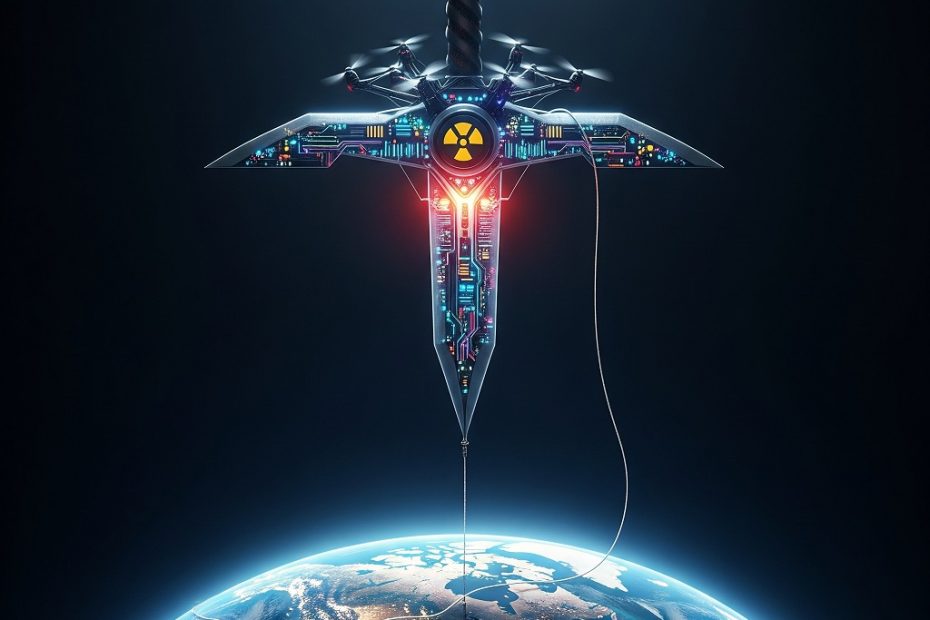
Introduction: Defining the Unthinkable
The concept of a “Third World War” occupies a unique and ominous space in the modern lexicon. It is not merely a term for a hypothetical future conflict but a powerful signifier laden with historical weight and profound anxiety. To analyze the contemporary risk of such a cataclysm, one must first deconstruct the term itself, understanding its origins, its evolution, and the dual meanings it has acquired. The very act of naming the 20th century’s global conflicts sequentially has created a psychological framework that implies recurrence, a narrative of inevitability that shapes both strategic planning and public consciousness. This report provides a comprehensive strategic analysis of the potential for a third world war, examining the current geopolitical landscape, the nature of modern conflict, its potential consequences, and the efficacy of international frameworks designed to prevent it.
Deconstructing “World War”
In the field of international relations, a “world war” is defined as an international conflict that involves most or all of the world’s major powers.1 This definition establishes a specific threshold of scale and participation that distinguishes such a conflict from the more frequent regional wars, civil wars, or insurgencies that populate the global landscape.3 While social science may offer a quantitative minimum for defining “war” as mass political violence resulting in at least 1,000 deaths, a world war, also termed a “systemic” or “global” war, represents the apex of this spectrum of violence.3
The idea of a globally integrated conflict predates the events of 1914. The term “world-war” appeared in a Scottish newspaper, The People’s Journal, as early as 1848, with the observation that “A war among the great powers is now necessarily a world-war”.2 This mid-19th-century insight, echoed in the writings of Karl Marx and Friedrich Engels, recognized that the growing interconnectedness of empires and economies meant that a clash between the dominant nations could no longer be a localized affair.2 The technological advances of the Second Industrial Revolution and the resulting globalization enabled global power projection and the mass production of military hardware, creating the conditions for the conflict of 1914-1918 to become the first world war “in the full sense of the word,” as the German philosopher Ernst Haeckel termed it in September 1914.2 The complex system of opposing military alliances and the vast overseas empires held by the belligerents virtually guaranteed that any spark could ignite a worldwide conflagration, as colonial resources became crucial strategic assets and colonial territories became secondary theaters of war.2
Fundamentally, war, in the Clausewitzian sense, is understood as “a true political instrument, a continuation of political intercourse, carried on with other means”.4 The primary means is organized physical violence, used to coerce an opponent and impose a group’s political will.4 A world war, therefore, is not merely random, widespread violence but a deliberate clash of political wills between the world’s major powers, fought on a global scale with the most destructive means available.
The Etymology and Conceptual Evolution of “World War III”
The coining of the term “World War I” by Time magazine on June 12, 1939, was a pivotal moment in shaping the modern perception of global conflict.2 In retrospectively renaming the “Great War,” it implicitly re-categorized a unique, catastrophic event as the first in a series. This was not a neutral act of nomenclature. In the very same article,
Time speculatively used the term “World War II” to describe the war that was then looming, a war that would officially begin less than three months later.2 This sequential numbering created a powerful linguistic and psychological precedent, embedding the idea of a recurring cycle of global warfare into the public mind.
The logical next step in this sequence, “World War III,” emerged with astonishing speed. The phrase appeared in another Time headline in its November 3, 1941 issue, a month before the attack on Pearl Harbor brought the United States into the Second World War.5 This was not a post-war reflection but a real-time fear, an acknowledgment that the underlying drivers of global conflict might not be resolved. As early as 1943, U.S. Vice President Henry A. Wallace was warning that the decisions made in the coming year would “plant the seeds of World War III”.7
With the end of World War II and the onset of the Cold War (1947–1991), the meaning of “World War III” crystallized, becoming almost entirely synonymous with a direct military confrontation between the United States-led Western Bloc and the Soviet-led Eastern Bloc.7 This hypothetical conflict was meticulously planned for. In April-May 1945, even before the previous war had formally concluded, the British Armed Forces developed Operation Unthinkable, a plan to “impose upon Russia the will of the United States and the British Empire,” considered the first scenario for a third world war.5 This was followed by numerous other strategic plans, such as the U.S. Operation Dropshot, and massive military exercises like Grand Slam and Reforger, all designed to game out a superpower clash.7
The development of the atomic bomb in 1945, and its use on Hiroshima and Nagasaki, irrevocably fused the concept of a third world war with the specter of nuclear annihilation.5 When the Soviet Union successfully tested its own atomic device in 1949, the fear was no longer of a repeat of the conventional carnage of WWII, but of a conflict that could lead to the collapse of modern civilization and potentially human extinction.5 This existential dread gave rise to the doctrine of Mutually Assured Destruction (MAD), a precarious peace held in place by the shared understanding that a full-scale war would mean the end for all participants.5
However, a parallel and critical understanding of the term emerged during this same period. Some scholars and analysts began to speak of a different “Third World War”—one that was not a hypothetical future event but an ongoing reality. This conception referred to the sum of the brutal proxy wars fought across the developing nations of Asia, Africa, and Latin America—the so-called “Third World”.10 While the superpowers avoided direct confrontation, their ideological struggle was waged by proxies, inflicting immense suffering and societal devastation. This “pervasive social warfare,” characterized by high civilian casualties and fought by non-professional forces, was a stupendous human tragedy that did not fit the neat academic definition of a “systemic war” because it did not involve direct combat between the major powers.11 This dual meaning persists today. The phrase “Third World War” can refer either to a future, high-tech, great-power conflict, likely involving nuclear weapons, or to the ongoing, interconnected web of regional and proxy conflicts that, in their totality, constitute a global struggle. Any credible analysis of the current risk must therefore contend with both possibilities: a singular, cataclysmic event, or the slow-burn intensification and convergence of existing violence into a de facto world war.
Section I: The Shifting Global Chessboard: Alliances and Antagonisms in a Multipolar Era
The post-Cold War “unipolar moment,” characterized by the unrivaled dominance of the United States, has definitively concluded. The contemporary international system is a complex, fluid, and increasingly unstable multipolar environment.12 This landscape is defined by the re-emergence of great-power competition, pitting a U.S.-led network of formal alliances against a looser, more opportunistic axis of revisionist powers. Complicating this dynamic is a large and influential group of “swing states,” primarily in the Global South, that are actively hedging their bets and resisting alignment with either bloc, creating what some analysts have termed a “geopolitical multiverse”.13
The U.S.-Led Bloc: A Formalized but Strained Network
The United States’ global power is projected through an extensive and historically unprecedented network of alliances and partnerships, the majority of which are formalized through binding treaties.15 This structure is America’s “great strategic advantage,” magnifying its strength and deepening its security.17
The cornerstone of this network is the North Atlantic Treaty Organization (NATO). Comprising 32 member states, NATO is a formal collective defense pact under which an attack on one member is considered an attack on all.16 Russia’s full-scale invasion of Ukraine in 2022 has “rejuvenated” the alliance, fostering greater intra-alliance cohesion, prompting new members like Finland and Sweden to join, and spurring increased defense spending among European partners, many of whom are now moving toward the target of spending 2% of GDP on defense.18
In the Indo-Pacific, U.S. strategy relies on a “hub-and-spokes” system of strong, bilateral defense treaties with key allies, including Japan, South Korea, the Philippines, and Australia (through the ANZUS treaty).17 These alliances are the foundation of the U.S. strategy to maintain regional stability and deter a rising China. They provide the U.S. with forward basing, enhance military interoperability through joint exercises, and enable collective responses to regional threats.17
In recent years, this traditional structure has been supplemented by newer, more flexible “minilateral” arrangements. Formats like AUKUS (a security pact between Australia, the United Kingdom, and the U.S. focused on sharing advanced military technology, notably nuclear-powered submarines) and the Quadrilateral Security Dialogue (the “Quad,” a strategic forum comprising the U.S., Japan, Australia, and India) are designed to be more agile and are explicitly aimed at balancing China’s growing power.13
Beyond these core alliances, the U.S. maintains a tiered system of global partnerships. This includes designating key partners as “Major Non-NATO Allies,” a status that provides military and economic benefits without a binding mutual defense commitment.16 This network is vast, encompassing over 180 countries with which the U.S. has diplomatic relations and over 120 with which it has logistics agreements, allowing for the global projection of power.17
However, this formidable network is not without its vulnerabilities. The “America First” foreign policy of the Trump administration created significant friction with traditional allies, who were subjected to tariffs and questioned on their commitment to burden-sharing.22 The possibility of a return to such policies creates strategic uncertainty for allies and has motivated key European powers like France and Germany to more seriously consider “strategic autonomy,” aiming to develop the capacity to act independently of the United States if necessary.13
The Revisionist Axis: A Partnership of Convenience
Opposing the U.S.-led order is a growing alignment of revisionist powers whose core objective is to challenge American dominance and establish a more “multipolar” world order that is more favorable to their autocratic systems.25 This bloc is less formalized than the U.S. network, functioning more as a partnership of convenience based on shared strategic goals.
The central pillar of this axis is the deepening strategic partnership between the People’s Republic of China (PRC) and the Russian Federation. While not a formal military alliance with a mutual defense clause, the relationship has been described by both sides as a “no-limits” partnership aimed at countering the U.S.-led global order.13 This alignment is pragmatic, rooted in a shared perception of the United States as a strategic adversary and a common desire to weaken its global influence.19
China, as the senior partner in this axis, deliberately eschews the Western model of formal, binding alliances. Instead, it has developed a highly flexible and nuanced system of “partnership diplomacy”.28 Beijing has established partnerships with nearly 100 countries and over 10 regional organizations.28 These relationships are tiered, with designations ranging from a basic “Cooperative Partnership” to a “Comprehensive Strategic Partnership” and, for its closest partners, unique titles like the “all-weather strategic cooperative partnership” with Pakistan and the “comprehensive strategic partnership of coordination for a new era” with Russia.26 This model allows Beijing to build influence and secure its interests—primarily economic and resource-driven—without the legal constraints and reciprocal obligations of a mutual defense treaty. Its primary tool of influence is economic statecraft, most notably through the globe-spanning Belt and Road Initiative (BRI), which provides infrastructure financing to developing nations.13
Russia’s own alliance network is more limited. Its primary formal military alliance, the Collective Security Treaty Organization (CSTO), which includes several former Soviet states, is widely regarded as a weak and ineffective institution, hampered by the internal divisions and divergent interests of its members.19 Consequently, Moscow’s more strategically significant partnerships are with other autocratic and revisionist states that share its anti-Western stance. This includes Iran and North Korea, which have become crucial military suppliers for Russia’s war effort in Ukraine, providing drones, artillery shells, and ballistic missiles in exchange for Russian technology, diplomatic support, and economic lifelines.29
There is a clear and growing convergence among this core group of China, Russia, Iran, and North Korea. Some expert surveys suggest this “axis of resistance” could evolve into a formal alliance by 2035, creating a more cohesive and formidable challenge to the Western-led order.21
The fundamental difference in how these two major blocs are structured is a critical factor in the current geopolitical landscape. The United States leads a network built on formal, legally binding, and often deeply integrated military alliances. These alliances, particularly NATO, are designed to generate immense collective military power through standardization and interoperability. However, their depth can also make them slower to act, as decisions may require consensus among many sovereign states. In contrast, the China-led bloc is a more agile and informal network of partnerships. It is primarily held together by shared economic interests and a common political opposition to the United States. This structure allows for greater flexibility and the effective use of economic and hybrid warfare tools, but it may lack the military cohesion and trust required for high-intensity, combined operations in a major war. A future global conflict would therefore not be a clash of symmetrical structures, but a contest between a deeply integrated military alliance system and a flexible, economically-driven strategic partnership network.
The “Geopolitical Multiverse”: Swing States and Strategic Hedging
The binary model of a new Cold War between a U.S. bloc and a Sino-Russian bloc is an oversimplification of the current global order. A significant and growing number of influential nations, particularly in the “Global South,” are deliberately avoiding firm alignment with either side.13 Major regional powers such as India, Brazil, Saudi Arabia, Turkey, and Indonesia are pursuing sophisticated “balancing” or “hedging” strategies designed to maximize their own strategic autonomy.13
This strategy often involves a pragmatic separation of economic and security interests. These nations frequently cultivate robust and expanding economic, trade, and investment relationships with China, while simultaneously strengthening their defense and security ties with the United States.13 India is the archetypal example of this phenomenon: it is a key member of the U.S.-led Quad, a group explicitly focused on countering China’s influence in the Indo-Pacific, yet it is also a prominent member of the China-centric Shanghai Cooperation Organisation (SCO) and the expanded BRICS forum.19 Similarly, Turkey is a treaty-bound member of NATO but has maintained a complex working relationship with Russia, even purchasing Russian air defense systems against the objections of its allies.
These nations are not passive observers in the great-power competition; they are active and independent poles in a genuinely multipolar system. Their “hedging” is not a sign of indecision but a deliberate foreign policy choice to avoid dependency and extract benefits from all sides. They are leveraging the competition between Washington and Beijing to advance their own interests. Forums like the expanded BRICS are being positioned by their members as diplomatic and economic alternatives to Western-dominated institutions like the G7, though they pointedly lack a collective defense mandate.13
This emergence of a powerful and assertive group of non-aligned states creates a “geopolitical multiverse”.14 It makes the international system far more complex and less predictable than the rigid bipolarity of the Cold War. The allegiance of these swing states cannot be taken for granted by either the U.S. or China, and their decisions on specific issues—from UN votes to technology standards to military access—can decisively tip the regional and even global balance of power. This dynamic forces the great powers into a constant state of competition for influence and increases the potential for strategic miscalculation, as the reactions of these crucial third parties are not guaranteed.
| Characteristic | U.S.-Aligned Bloc | China/Russia-Aligned Bloc | Key Non-Aligned/Swing Powers |
| Core Members | United States, United Kingdom, France, Germany, Japan, South Korea, Australia, Canada 16 | People’s Republic of China, Russian Federation, Iran, North Korea 30 | India, Brazil, Saudi Arabia, Turkey, Indonesia, South Africa 13 |
| Key Alliances/Partnerships | NATO, AUKUS, Quad, ANZUS, Bilateral Defense Treaties (e.g., with Japan, South Korea, Philippines) 16 | “No-limits” partnership (China-Russia), SCO, CSTO, Belt and Road Initiative (BRI), Ad-hoc military support (e.g., Iran/NK to Russia) 19 | BRICS, G20, Non-Aligned Movement (NAM), Regional bodies (e.g., ASEAN, African Union) 13 |
| Stated Strategic Goals | Uphold the “rules-based international order,” promote democracy, maintain global security and stability 17 | Establish a “multipolar” world, counter U.S. hegemony, secure spheres of influence, ensure regime survival 25 | “Strategic autonomy,” multi-alignment, economic development, regional leadership, non-interference 13 |
| Primary Tools of Influence | Formal military alliances, economic sanctions, technological leadership, diplomatic coalitions, development aid 15 | Economic investment (BRI), energy and resource politics, cyber operations, proxy support, disinformation, military sales 13 | Balancing diplomacy, control over strategic resources (e.g., oil) and supply chains, demographic weight, regional institution-building 13 |
| Internal Cohesion | High on paper due to binding treaties, but subject to internal political shifts and debates over burden-sharing and strategic priorities 13 | Pragmatic and opportunistic; high alignment on anti-U.S. posture but lacks deep military integration and can be strained by competing national interests 19 | Highly independent and issue-dependent; cohesion within groups like BRICS is primarily economic and diplomatic, not strategic or military 13 |
Section II: Flashpoints and Escalation Ladders
The current multipolar environment is fraught with tension, featuring several volatile regions where local disputes are dangerously intertwined with great-power competition. A conflict in any of these flashpoints holds the potential to escalate, through miscalculation or deliberate action, into a direct confrontation between major powers and their allies, thereby triggering a world war. The primary danger lies not in a single, isolated crisis but in the interconnected nature of these theaters, where an eruption in one could have cascading and destabilizing effects across the globe. A fundamental shift has occurred in which revisionist powers increasingly view war not as a last resort, but as a viable instrument of state policy to achieve their strategic objectives, marking a definitive end to the post-Cold War order and creating a “pre-war” environment.31
High-Risk Flashpoint 1: The Taiwan Strait (U.S. vs. China)
The dispute over Taiwan remains the most perilous flashpoint for a direct conflict between the United States and China. The core of the conflict lies in the PRC’s long-standing claim of sovereignty over the self-governing democracy of Taiwan, which Beijing views as a “renegade province” to be unified with the mainland, by force if necessary.35 This is set against Taiwan’s vibrant democracy and the United States’ decades-long policy of “strategic ambiguity,” which leaves intentionally vague whether it would intervene militarily to defend Taiwan from an invasion.20
Expert consensus overwhelmingly identifies this as the most likely trigger for a U.S.-China war, and by extension, a third world war. A 2025 survey by the Atlantic Council revealed that among experts who predict a world war within the next decade, a staggering 79% believe China will attempt to forcibly retake Taiwan during that timeframe.30 Other strategic risk assessments categorize the probability of a conflict over Taiwan as “High”.36
The escalation pathway is stark and direct. A Chinese military action—ranging from a full-scale amphibious invasion to a naval and air blockade designed to strangle the island into submission—would present a direct challenge to the U.S.-led order in the Indo-Pacific. A failure by the United States to respond would shatter its credibility with key regional allies like Japan and South Korea, potentially leading to the collapse of its alliance system in Asia. Consequently, U.S. intervention is considered highly probable.20 Such an intervention would almost certainly draw in regional U.S. allies, particularly Japan, whose southern islands are in close proximity to Taiwan and host major U.S. military bases, and potentially Australia under the terms of the ANZUS treaty.20 A detailed scenario developed by the U.S. Naval Institute outlines a plausible path to war in 2026, beginning with rising political tensions following a Taiwanese election and culminating in a military collision in the Taiwan Strait that serves as the final spark.35
Strategic planners and intelligence agencies are therefore monitoring a specific set of early warning indicators for such a conflict. These include large-scale mobilizations and deployments of the People’s Liberation Army Navy (PLAN) and Air Force, the declaration of military exclusion zones or airspace closures around Taiwan, the forward movement of U.S. aircraft carrier strike groups into the Western Pacific, and the mobilization of Taiwan’s military reserves.36
High-Risk Flashpoint 2: The European Frontier (Russia vs. NATO)
The war in Ukraine has transformed the security landscape of Europe, creating a direct and active frontier of confrontation between Russia and the NATO alliance. The core dispute is driven by Russia’s strategic goal of re-establishing a sphere of influence over the territory of the former Soviet Union, halting and reversing NATO’s eastward expansion, and ultimately fracturing the transatlantic alliance.25 This stands in direct opposition to NATO’s foundational principle of collective defense, enshrined in Article 5 of the Washington Treaty, which commits all members to defend one another against attack.19
The risk of a direct military clash between Russia and NATO, once a remote Cold War-era concern, has become a tangible possibility. Expert assessments reflect this heightened danger; 69% of those surveyed by the Atlantic Council who foresee a world war believe a direct Russia-NATO conflict will occur within the decade.30 Other analyses rate this risk as “Very High,” the most severe category.36
Escalation from the current proxy war in Ukraine to a direct war could occur through several pathways. The first is through accident or miscalculation. In a highly charged environment with large concentrations of opposing forces operating in close proximity, a single incident—such as a Russian missile straying into Polish or Romanian airspace and causing casualties, or a direct aerial or naval engagement between Russian and NATO forces over the Black Sea—could be misinterpreted as a deliberate act of aggression, triggering a retaliatory spiral that is difficult to control.34
The second pathway is through deliberate Russian aggression. A scenario frequently discussed in Western defense circles involves a future, reconstituted Russian military, having achieved its objectives or a frozen conflict in Ukraine, deciding to test NATO’s credibility and cohesion. This could take the form of a limited, hybrid, or conventional attack on one of the Baltic states (Estonia, Latvia, or Lithuania), calculated on the assumption that the Alliance would lack the political will for a full-scale response, particularly if the United States were distracted by a simultaneous crisis in the Indo-Pacific.31
Key warning indicators for this flashpoint include the movement and deployment of Russian tactical nuclear weapons to forward positions, a significant elevation in NATO’s force posture and alert levels (such as a full activation of the NATO Response Force), major Russian cyberattacks targeting the critical infrastructure of NATO members, or a significant strategic shift on the battlefield in Ukraine, such as a Ukrainian advance toward the Crimean Peninsula that Moscow might perceive as an existential threat.36
Medium-to-High Risk Flashpoint 3: The Middle East Cauldron (Iran and Proxies vs. Israel and the U.S.)
The Middle East remains a cauldron of instability, characterized by the long-running shadow war between Iran and Israel, Tehran’s advancing nuclear program, and the destabilizing actions of a network of Iranian-backed proxy forces, including Hezbollah in Lebanon, the Houthis in Yemen, and various militias in Iraq and Syria.31
While a conflict in the Middle East is seen as less likely to independently spark a third world war, it functions as a critical “accelerant” or “amplifier” due to the dense web of alliances connecting the regional players to the global great powers.31 The risk of a major regional conflagration is assessed as “Medium-High and rising”.36
A regional conflict could escalate to global significance through several scenarios. A full-scale war between Israel and Hezbollah, which possesses an arsenal of well over 100,000 rockets and missiles, would be far more destructive than previous conflicts and could draw in direct Iranian intervention. Alternatively, an Israeli preemptive military strike against Iran’s nuclear facilities to prevent Tehran from acquiring a nuclear weapon would almost certainly provoke a massive, multi-front retaliation from Iran and its proxies against Israeli and U.S. targets across the region.36
Such a regional war would immediately become a global crisis because of the alliances at play. The United States is Israel’s primary security guarantor and would almost certainly be drawn in to defend its ally and its own forces in the region.34 Simultaneously, Iran has become a crucial strategic partner for Russia and China. It supplies Russia with vital military hardware for its war in Ukraine and is a key node in China’s Belt and Road Initiative.29 A U.S.-Iran conflict would therefore place Washington in direct opposition to a partner of its main strategic rivals, creating immense pressure on the entire international system.
Warning indicators for this flashpoint are clear: Iran enriching uranium to weapons-grade levels (90% purity), a sustained, large-scale missile barrage from Hezbollah against Israeli population centers, or direct, overt military strikes between the territories of Iran and Israel.36
The gravest danger facing the international community is not the eruption of a single crisis in one of these flashpoints, but the simultaneous or rapidly sequential outbreak of conflict across multiple theaters. The United States, as the common node and primary security guarantor in all three regions—for NATO in Europe, for allies like Japan and Taiwan in Asia, and for Israel in the Middle East—could find its military resources and political attention stretched to the breaking point.17 A major war with China over Taiwan would severely degrade the U.S. ability to reinforce Europe, a reality that could embolden Russia to act aggressively against NATO. Conversely, a full-scale war between NATO and Russia in Europe would necessarily divert U.S. assets from the Pacific, potentially creating what Beijing might perceive as a temporary window of opportunity to resolve the Taiwan issue on its terms. Iran, observing its great-power patrons engaged with the U.S. on other fronts, might feel similarly emboldened to act against Israel or U.S. interests in the Gulf. This potential for a cascading failure of deterrence across interconnected theaters is the most plausible pathway to a “multifront conflict among great powers”—the very definition of a third world war.30
Section III: The Character of a 21st-Century World War
A third world war would bear little resemblance to its 20th-century predecessors. The industrial-age conflicts defined by massed armies, attrition, and clear distinctions between the front lines and the home front are obsolete. A future global conflict would be a hyper-complex, multi-domain war fought simultaneously across land, sea, air, space, and cyberspace. It would be characterized by the fusion of advanced technology, novel warfighting doctrines that erase the line between war and peace, and the weaponization of the very interconnectedness that defines the modern world.
| Characteristic | World War I (1914-1918) | World War II (1939-1945) | Potential World War III |
| Key Belligerents | Central Powers vs. Allied Powers 39 | Axis Powers vs. Allied Powers 39 | U.S./NATO Bloc vs. China/Russia Bloc 30 |
| Primary Theaters | Europe (Western & Eastern Fronts), Middle East, Colonies 2 | Europe, Pacific, North Africa, Atlantic 39 | Global: Indo-Pacific, Europe, Middle East, Space, Cyberspace 30 |
| Core Military Technologies | Machine gun, heavy artillery, poison gas, early aircraft & tanks, barbed wire 41 | Advanced tanks, strategic bombers, aircraft carriers, radar, rocketry, atomic bomb 43 | Artificial intelligence, hypersonic weapons, autonomous systems (drones), directed energy, cyber weapons, biotechnology 46 |
| Dominant Military Doctrine | Attrition, trench warfare, mass infantry assaults 41 | Blitzkrieg, combined arms operations, strategic bombing, amphibious assault 43 | Multi-Domain Operations, hybrid warfare, information dominance, supply chain warfare, algorithmic warfare 33 |
| Information/Cyber Domain | Propaganda posters, telegraph, field telephones 44 | Radio communications, cryptography (Enigma), widespread propaganda films 44 | Pervasive cyber warfare (infrastructure attacks), weaponized social media, deepfakes, information as a primary battlespace 33 |
| Space Domain | Non-existent | Early rocketry (V-2 rocket) as a precursor 42 | Fully contested military domain: anti-satellite weapons, militarized satellite constellations, space-based surveillance and targeting 30 |
| Civilian Impact | High casualties, but primarily as a consequence of military operations and blockade 11 | Extremely high, deliberate targeting of cities (strategic bombing), genocide, societal mobilization 11 | Primary target of conflict through infrastructure collapse, societal manipulation, economic warfare, and potential nuclear annihilation 11 |
From Industrial Attrition to Information Dominance: The Technological Chasm
The world wars of the 20th century were products of the industrial age. World War I was dominated by the defensive power of the machine gun and artillery, which created the bloody stalemate of trench warfare.41 The interwar period saw military theorists and engineers develop the technologies and doctrines needed to overcome this stalemate. World War II was the result: a war of mobility restored by the triad of the internal combustion engine (tanks, mechanized infantry), advanced aircraft, and wireless radio communications, which enabled the combined arms tactics of Blitzkrieg.43 Both were wars of mass mobilization and industrial production.42
A 21st-century world war would be an information-age conflict, defined by technologies that compress time and space and blur the physical and virtual worlds.
- The New High Grounds: Space and Cyberspace. From its opening moments, a future war would be fought in domains that were nascent or non-existent in 1945. The global economy and modern militaries are critically dependent on space-based assets for communication, navigation (GPS), and intelligence. A conflict would therefore see immediate attempts to disable or destroy an adversary’s satellites, creating a “contested domain” in orbit and potentially blinding forces on the ground.30 Simultaneously, cyberattacks would target not only military command-and-control networks but also the civilian critical infrastructure—power grids, financial systems, transportation networks—that underpins a nation’s ability to wage war, seeking to induce societal collapse from within.47
- The Algorithmic Battlefield: AI and Autonomy. Artificial intelligence is set to revolutionize warfare. AI algorithms will be used to sift through vast amounts of sensor data to identify targets, optimize logistics, and run battle simulations at speeds far beyond human cognition.46 This will lead to the proliferation of autonomous and semi-autonomous systems, from drone swarms to robotic ground vehicles. This accelerates the “kill chain” and the entire tempo of battle, creating immense pressure on human decision-makers and raising profound ethical questions about delegating life-or-death decisions to machines.5
- The End of Sanctuary: Hypersonics and Precision Strike. The development of hypersonic missiles—which travel at over five times the speed of sound and are highly maneuverable—and the proliferation of long-range precision-guided munitions have effectively erased the concept of a safe “rear area.” In past wars, command centers, logistics hubs, and industrial bases were relatively secure. In a future conflict, these vital nodes would be vulnerable to attack from thousands of kilometers away within the first minutes of hostilities, threatening to decapitate an opponent’s leadership and cripple their war effort before it can fully mobilize.
The Evolution of Warfighting Doctrine
The technologies of a future war are driving a corresponding evolution in military doctrine. The concept of a clear, declared war fought between uniformed armies on a defined battlefield is being superseded by more ambiguous and continuous forms of conflict.
- Hybrid and Gray-Zone Warfare. A third world war would not be fought solely with conventional military force. Adversaries are already employing a “fused mix of conventional weapons, irregular tactics, terrorism and criminal behavior” to achieve their objectives.54 This doctrine of “hybrid warfare” involves using a wide spectrum of tools—including non-state proxies, political subversion, economic coercion, cyberattacks, and sophisticated disinformation campaigns—to weaken an adversary while remaining below the threshold of actions that would typically trigger a conventional military response.33 Russia’s initial invasion of Ukraine in 2014, using “little green men” and local separatists, and China’s use of its maritime militia and coast guard to assert claims in the South China Sea are textbook examples of operating in this “gray zone” between peace and war.33
- The Weaponization of Interdependence: Supply Chain Warfare. The paradox of globalization is that the very interconnectedness once thought to promote peace has created new, potent vulnerabilities. Modern economies rely on complex, globe-spanning supply chains, which have now become a central battlefield.50 A modern great-power conflict would feature the deliberate targeting of these economic lifelines. This “supply chain warfare” involves using tariffs, sanctions, and export controls on critical technologies (like advanced semiconductors) and resources (like rare earth minerals or energy) as tactical weapons to inflict severe economic pain and cripple an adversary’s industrial capacity.32
- The Battle of the Narrative: Pervasive Information Warfare. The struggle for narrative dominance would be a central, co-equal theater of operations. States would deploy sophisticated, AI-enhanced disinformation and propaganda campaigns through social media and other channels to manipulate public opinion, both at home and in enemy and neutral countries.4 The goal would be to sow societal division, undermine political will, erode trust in institutions, and fracture alliances, thereby weakening an adversary’s ability to fight before a single shot is fired.38 The constant barrage of conflicting information would make it exceptionally difficult for citizens and policymakers to discern objective reality.
This doctrinal evolution suggests that the traditional binary state of being either “at war” or “at peace” is becoming obsolete. Great powers are already engaged in continuous, low-level acts of strategic hostility against one another through cyber intrusions, economic pressure, and information campaigns. A “third world war” might not, therefore, have a clear start date like the invasion of Poland in 1939. Instead, it could manifest as a rapid phase transition, where the ongoing “gray zone” conflict crosses a critical threshold of violence and intensity, becoming a recognized state of total war. From this perspective, the international system may already be in the opening stages of such a conflict.
Alternative Conceptions: A “World War” of Converging Conflicts
An alternative and compelling critique challenges the notion that a future global conflict would necessarily resemble the singular, declared total wars of the 20th century. Instead, it could manifest as a “Third World War” in the sense proposed by some analysts during the Cold War: a condition of pervasive, interconnected, and decentralized violence that is global in its cumulative impact, even if the great powers are not direct combatants in every theater.11
This model posits that the world is already experiencing a form of low-grade global conflict. This is evidenced by the proliferation of major proxy wars—in Ukraine, Yemen, Syria, and parts of Africa—where great powers back opposing sides.2 Furthermore, data from institutions like the Peace Research Institute Oslo (PRIO) shows that the number of state-based armed conflicts globally is at its highest point since the end of World War II, with violence becoming more complex and fragmented.59 In this view, a “Third World War” would not be a new, discrete event but rather the
intensification and fusion of these numerous existing conflicts. A crisis in one region could trigger and merge with crises in others, until the separate conflicts coalesce into a single, interlocking global system of violence that overwhelms the international order.
Section IV: The Unbearable Consequences
A third world war, particularly one involving the use of nuclear weapons, would unleash devastation on a scale that would dwarf the horrors of the 20th century. The combination of modern weaponry, highly urbanized global populations, and a fragile, interconnected civilization means that the consequences would be synergistic and cascading. The humanitarian, economic, and environmental impacts would not be separate crises but a single, self-reinforcing system collapse, rendering traditional notions of “victory” and “defeat” utterly meaningless.
Humanitarian Catastrophe: A Global Toll
The immediate human cost of a great-power conflict would be staggering. Modern conventional weapons alone possess immense destructive power, but the introduction of nuclear weapons would result in an immediate, catastrophic loss of life, with the potential to annihilate major population centers in minutes.61
Unlike the wars of the past, modern societies are overwhelmingly urban. This concentration of population means that civilians would not be incidental casualties; they would be the primary victims.53 The deliberate or collateral destruction of dense urban areas would lead to a complete breakdown of the essential services that sustain life. The destruction of hospitals, power grids, water purification plants, and sanitation systems would trigger secondary waves of death from disease, starvation, and exposure.53 Medical services would cease to function, vaccination campaigns would halt, and the chance of epidemics would soar.53
The conflict would also create a humanitarian crisis of displacement on an unimaginable scale. Millions, potentially billions, of people would be forced to flee their homes, becoming refugees or internally displaced persons and overwhelming the capacity of any conceivable international aid response.53 For the survivors, the psychological trauma would be profound and enduring. Widespread post-traumatic stress disorder, depression, and anxiety would inflict deep scars on the collective human psyche, shaping the worldview of generations to come.61
Economic Annihilation: System Collapse
The global economy, a tightly integrated system of trade, finance, and production, would completely disintegrate. A third world war would involve the physical destruction of key industrial regions, transportation hubs, and communication networks, leading to a global economic depression far more severe than that of the 1930s.61 The economic impact of violence is already immense; in 2017, the Institute for Economics & Peace calculated the cost at $14.76 trillion, or 12.4% of global GDP, in a world largely at peace.62 A global war would multiply this figure many times over.
The hyper-specialized, just-in-time global supply chains that underpin modern life would be among the first casualties. As seen in the doctrine of supply chain warfare, these networks would be deliberately targeted, causing a complete breakdown in the flow of essential goods, including food, medicine, energy, and critical technological components.32 This would lead to catastrophic shortages worldwide.
The global financial system would face an immediate and terminal crisis. Markets would crash, international trade would cease, and the intricate web of credit and debt that facilitates the global economy would unravel. Many national currencies would likely collapse into hyperinflation, destroying savings and making economic activity impossible.32 The resources required for any post-war reconstruction would be colossal, but the capacity to generate and coordinate those resources would have been annihilated.61
Environmental Collapse: The Nuclear Winter Scenario
The most terrifying and unique consequence of a nuclear third world war would be its long-term impact on the global environment. Scientific models have consistently shown that a nuclear exchange would trigger a catastrophic climatic shift known as “nuclear winter”.64
The mechanism is straightforward. The firestorms ignited by nuclear detonations in cities and industrial areas would inject enormous quantities of soot and smoke into the upper atmosphere.65 This dense layer of aerosol particles would spread across the hemisphere, blocking a significant portion of incoming sunlight from reaching the Earth’s surface.67
The result would be an abrupt, dramatic, and prolonged drop in global temperatures. This “nuclear winter” would lead to a drastic shortening of growing seasons or their elimination altogether in many of the world’s breadbasket regions, causing the collapse of global agriculture and leading to a worldwide famine.64 Even a so-called “limited” regional nuclear war, for instance between India and Pakistan, could produce enough soot to cause a global food crisis.65
The environmental effects would be long-lasting and multifaceted. The global cooling would cause a “Nuclear Little Ice Age,” leading to a massive expansion of Arctic sea ice that could persist for thousands of years.66 Ocean temperatures would plummet, taking decades to recover at the surface and hundreds or even thousands of years in the deep ocean. This would devastate marine ecosystems, leading to a collapse in global fish stocks, another vital food source.66 Furthermore, the chemical reactions in the soot-filled atmosphere would lead to a partial destruction of the protective ozone layer, allowing harmful levels of ultraviolet radiation to reach the surface.67 The war would also create a legacy of widespread chemical and radiological contamination, as thousands of destroyed industrial and urban sites would become the equivalent of permanent toxic waste dumps, leaching poisons like dioxins into the environment.67
The synergistic nature of these consequences is what makes them so apocalyptic. The environmental collapse of a nuclear winter would directly cause a humanitarian catastrophe in the form of global famine. This humanitarian crisis, characterized by mass starvation and societal breakdown, would make any form of economic recovery impossible. The economic collapse, in turn, would prevent the marshalling of any resources to mitigate the humanitarian or environmental disasters. This is not a cycle from which a civilization can easily rebuild; it is a self-reinforcing feedback loop of collapse. This reality underscores the ultimate futility of such a conflict. In a conventional war, a “victor” can achieve political goals and rebuild from the ashes. However, the global and self-inflicted nature of nuclear winter means there can be no meaningful victor in a nuclear third world war. The environmental consequences would be shared by all nations, including the aggressor, rendering the initial political objectives for which the war was fought entirely moot. The only outcome would be shared, global ruin.
Conclusion: Navigating the Pre-War Era
The analysis presented in this report leads to a sobering conclusion: the risk of a third world war, understood as a direct conflict between great powers, is higher than at any point since the darkest moments of the Cold War. A confluence of dangerous trends—the rise of assertive revisionist powers, the fracturing of the global order into competing blocs, the proliferation of disruptive military technologies, the erosion of international norms against aggression, and the existence of multiple, interconnected flashpoints—has created a strategic environment of profound instability. Expert consensus and public anxiety reflect a growing sense of foreboding, a feeling that the world is transitioning from a “post-war” to a “pre-war” state.30
The international order built after 1945 to prevent such a catastrophe appears increasingly unequal to the task. The foundational principle of the United Nations Charter, the prohibition on the aggressive use of force, has been repeatedly violated with little consequence, leading many to question the efficacy of international law when confronted by a determined great power.69 The UN Security Council, the primary institution for maintaining international peace, is often paralyzed by the veto power held by the very states most likely to be protagonists in a future conflict, rendering it ineffective in crises involving their core interests.72 A comprehensive meta-analysis of international treaties—the bedrock of the legal order—found that they have largely failed to produce their intended effects in the realms of security and humanitarian affairs, succeeding primarily in the less contentious domains of trade and finance.74
The core of the problem is not a lack of rules, but a crisis of enforcement. The liberal international order was predicated on the assumption that its core tenets would be upheld, by consensus if possible and by the power of its leading members if necessary. That consensus has shattered, and the will to enforce the rules against major challengers has been tested and found wanting. The current “pre-war” era is a direct result of this enforcement failure. It demonstrates that preventing a great-power war cannot rely on appeals to a legal framework that its challengers no longer respect.
Yet, conflict is not inevitable. The catastrophic consequences of a great-power war, particularly the certainty of mutual annihilation in a nuclear exchange, remain a powerful, if not entirely foolproof, deterrent. Navigating this perilous period requires a clear-eyed and unsentimental approach grounded in three core principles:
- Revitalized Deterrence: In an environment where revisionist powers view major war as a legitimate tool of policy, deterrence can no longer be based on the hope that adversaries share a common interest in preserving the status quo. It must be based on the credible military capability and unambiguous political will to defeat aggression. This necessitates strengthening alliances like NATO, modernizing military forces to meet the challenges of a multi-domain battlefield, and clearly communicating the unacceptable costs that will be imposed on any aggressor.20
- Strategic Diplomacy: Even as military readiness is enhanced, robust channels of communication with adversaries must be maintained. The primary goal of diplomacy in a pre-war era is not necessarily to resolve underlying geopolitical disagreements, which may be intractable, but to manage competition, establish clear red lines, and prevent the miscalculations and accidental escalations that are a primary danger in a tense, multi-flashpoint world.38
- Defensive Economic Statecraft: The paradox of interconnectedness—that it creates both shared interests and new vulnerabilities—demands a sophisticated approach to economic policy. The U.S. and its allies must work to “de-risk” their economies by building resilience in critical supply chains for goods like semiconductors, pharmaceuticals, and strategic minerals.14 This defensive posture must be paired with the judicious use of offensive economic tools, such as targeted sanctions and export controls, to impose costs on aggressors, while remaining aware that such measures can also escalate tensions and harm the global economy.32
The challenge for policymakers is immense. It requires navigating a path between the twin dangers of provocation and appeasement, and between the extremes of fatalism and complacency. The world is standing on a precipice, but the fall is not preordained. The responsibility for preventing a third world war rests on the capacity of the world’s leaders to restore a credible balance of power, to manage their rivalries with wisdom and restraint, and to never lose sight of the unbearable consequences of failure.
Works cited
- en.wikipedia.org, accessed July 17, 2025, https://en.wikipedia.org/wiki/World_war#:~:text=A%20world%20war%20is%20an,of%20the%20world’s%20major%20powers.
- World war – Wikipedia, accessed July 17, 2025, https://en.wikipedia.org/wiki/World_war
- International Relations – War – Oxford Bibliographies, accessed July 17, 2025, https://www.oxfordbibliographies.com/abstract/document/obo-9780199743292/obo-9780199743292-0049.xml
- What Is War? Defining War, Conflict and Competition – Australian Army Research Centre, accessed July 17, 2025, https://researchcentre.army.gov.au/library/land-power-forum/what-war-defining-war-conflict-and-competition
- How Long Have People Feared a ‘World War III’? | HISTORY, accessed July 17, 2025, https://www.history.com/articles/weve-been-talking-about-world-war-iii-since-before-pearl-harbor
- www.history.com, accessed July 17, 2025, https://www.history.com/articles/weve-been-talking-about-world-war-iii-since-before-pearl-harbor#:~:text=The%20phrase%20seems%20to%20have,entry%20into%20World%20War%20II.
- World War III – Wikipedia, accessed July 17, 2025, https://en.wikipedia.org/wiki/World_War_III
- All About The World War 2 And Third World War – Unacademy, accessed July 17, 2025, https://unacademy.com/content/nda/study-material/polity/all-about-the-world-war-2-and-third-world-war/
- en.wikipedia.org, accessed July 17, 2025, https://en.wikipedia.org/wiki/World_War_III#:~:text=World%20War%20III%20was%20initially,and%20Soviet%2Dled%20Eastern%20Bloc.
- (PDF) The making of the third world: Is the term still meaningful and useful? – ResearchGate, accessed July 17, 2025, https://www.researchgate.net/publication/283247423_The_making_of_the_third_world_Is_the_term_still_meaningful_and_useful
- The Global System and the Third World War, accessed July 17, 2025, https://www.systemicpeace.org/tww/twwchp1.pdf
- World War III? What global experts are starting to say out loud – AS USA – Diario AS, accessed July 17, 2025, https://en.as.com/latest_news/world-war-iii-what-global-experts-are-starting-to-say-out-loud-n/
- Global Trends 2024: EXISTING ALLIANCES ON THE GLOBAL …, accessed July 17, 2025, http://prismua.org/en/english-global-trends-2024-existing-alliances-on-the-global-geopolitical-map/
- Top 10 geopolitical developments for 2024 – EY, accessed July 17, 2025, https://www.ey.com/en_it/insights/geostrategy/2024-geostrategic-outlook
- Alliances vs. Partnerships – Department of Defense, accessed July 17, 2025, https://www.defense.gov/News/Feature-Stories/story/Article/1684641/alliances-vs-partnerships/
- Who Are The US Allies: Understanding The Foreign Relations of the United States, accessed July 17, 2025, https://executivegov.com/articles/who-are-the-us-allies-understanding-the-foreign-relations-of-the-united-states
- Austin: U.S. Leadership, Alliances Make for a More Secure World – Department of Defense, accessed July 17, 2025, https://www.defense.gov/News/News-Stories/Article/Article/3989611/austin-us-leadership-alliances-make-for-a-more-secure-world/
- Foreign relations of the United States – Wikipedia, accessed July 17, 2025, https://en.wikipedia.org/wiki/Foreign_relations_of_the_United_States
- Military Alliances of the Great Powers — Russia in Global Affairs, accessed July 17, 2025, https://eng.globalaffairs.ru/articles/military-alliances-muhammad/
- Strengthening US Alliances in the Indo-Pacific – Foreign Policy Research Institute, accessed July 17, 2025, https://www.fpri.org/article/2025/03/strengthening-us-alliances-in-the-indo-pacific/
- MILITARY ALLIANCES OF THE WORLD – Dış Politika Enstitüsü, accessed July 17, 2025, https://foreignpolicy.org.tr/military-alliances-of-the-world/
- World Superpowers 2025 – World Population Review, accessed July 17, 2025, https://worldpopulationreview.com/country-rankings/world-superpowers
- Global views of China and Xi improve, while they decline about the US and Trump, survey says, accessed July 17, 2025, https://apnews.com/article/us-china-trump-xi-survey-856841f6c7c8d5377e384ada2e65cb2b
- Senate Democrats say Trump’s policies are hurting America’s ability to compete with China, accessed July 17, 2025, https://apnews.com/article/china-trump-usaid-influence-visa-48bb3a3cdb11f8f9622addb3954ff3b9
- Backing into World War III – Brookings Institution, accessed July 17, 2025, https://www.brookings.edu/articles/backing-into-world-war-iii/
- CHINA’S “PARTNERSHIPS” WITH THE WORLD, accessed July 17, 2025, https://www.orcasia.org/article/347/chinas-partnerships-with-the-world
- Foreign relations of China – Wikipedia, accessed July 17, 2025, https://en.wikipedia.org/wiki/Foreign_relations_of_China
- What “Partnerships” Does China Have? – Interpret, accessed July 17, 2025, https://interpret.csis.org/translations/what-partnerships-does-china-have/
- Global threat: Russia and its autocratic allies – Ukraїner, accessed July 17, 2025, https://www.ukrainer.net/en/russia-and-allies/
- Welcome to 2035: What the world could look like in ten years …, accessed July 17, 2025, https://www.atlanticcouncil.org/content-series/atlantic-council-strategy-paper-series/welcome-to-2035/
- Are we heading for World War Three? Experts give their verdicts – Sky News, accessed July 17, 2025, https://news.sky.com/story/are-we-heading-for-world-war-three-experts-weigh-up-whether-russia-china-and-the-middle-east-could-lead-us-into-apocalyptic-conflict-13056131
- The cost of modern warfare goes beyond bullets – The Hans India, accessed July 17, 2025, https://www.thehansindia.com/hans/opinion/news-analysis/the-cost-of-modern-warfare-goes-beyond-bullets-974413
- What is Hybrid Warfare? Non-Linear Combat in the 21st Century, accessed July 17, 2025, https://globalsecurityreview.com/hybrid-and-non-linear-warfare-systematically-erases-the-divide-between-war-peace/
- Are we heading for World War Three? Experts give their verdicts – Sky News, accessed July 17, 2025, https://news.sky.com/story/are-we-heading-for-world-war-three-experts-give-their-verdicts-13116540
- The War of 2026: Phase III Scenario | Proceedings – U.S. Naval Institute, accessed July 17, 2025, https://www.usni.org/magazines/proceedings/2023/december/war-2026-phase-iii-scenario
- The Precipice of World War III: Global Flashpoints, Escalation Pathways, and Early Warning Systems – PowerMentor, accessed July 17, 2025, https://www.powermentor.org/blog/the-precipice-of-world-war-iii-global-flashpoints-escalation-pathways-and-early-warning-systems
- 5 terrifying flashpoints that could ignite global war – Fox News, accessed July 17, 2025, https://www.foxnews.com/opinion/5-terrifying-flashpoints-could-ignite-global-war
- World War III — Geopolitics, Technology, and the Coming Global Conflict – Medium, accessed July 17, 2025, https://medium.com/@mcraddock/world-war-iii-geopolitics-technology-and-the-coming-global-conflict-1a89c1f74ac6
- World War I | Causes, Years, Combatants, Casualties, Maps, & Facts | Britannica, accessed July 17, 2025, https://www.britannica.com/event/World-War-I
- World War 3 likely in next 5-10 years, think most Britons | YouGov, accessed July 17, 2025, https://yougov.co.uk/politics/articles/48527-world-war-3-likely-in-next-5-10-years-think-most-britons
- World War I – (Intro to International Relations) – Vocab, Definition, Explanations | Fiveable, accessed July 17, 2025, https://library.fiveable.me/key-terms/introduction-international-relations/world-war-i
- Military Developments of World War I – 1914-1918 Online, accessed July 17, 2025, https://encyclopedia.1914-1918-online.net/article/military-developments-of-world-war-i/
- Interwar period – Wikipedia, accessed July 17, 2025, https://en.wikipedia.org/wiki/Interwar_period
- World War I & World War II – Science Technology and Society a Student Led Exploration – Clemson University Open Textbooks, accessed July 17, 2025, https://opentextbooks.clemson.edu/sciencetechnologyandsociety/chapter/world-war-i-world-war-ii/
- World War I vs. World War II – Difference and Comparison – Battle Archives, accessed July 17, 2025, https://battlearchives.com/blogs/news/world-war-i-vs-world-war-ii-difference-and-comparison
- The Evolution of Military Doctrine – Number Analytics, accessed July 17, 2025, https://www.numberanalytics.com/blog/evolution-of-military-doctrine
- The Impact of Technology on Modern Warfare – Quorum, accessed July 17, 2025, https://www.qlsl.com/2024/02/the-impact-of-technology-on-modern-warfare/
- What significant differences were there if any, between WW1 trenches and WW2 trenches?, accessed July 17, 2025, https://www.reddit.com/r/history/comments/rjmzo7/what_significant_differences_were_there_if_any/
- Warfare tactics changed greatly between WW1 and WW2 – how and when did this occur? : r/AskHistorians – Reddit, accessed July 17, 2025, https://www.reddit.com/r/AskHistorians/comments/2r7ac7/warfare_tactics_changed_greatly_between_ww1_and/
- Supply Chain Warfare: The New Front in Gray Zone Conflict – interos.ai, accessed July 17, 2025, https://www.interos.ai/blog/supply-chain-warfare/
- The Mirage of the Interconnected Battlefield – Modern War Institute, accessed July 17, 2025, https://mwi.westpoint.edu/the-mirage-of-the-interconnected-battlefield/
- Observatory on Future Conflicts – Ifri, accessed July 17, 2025, https://www.ifri.org/en/observatory-future-conflicts
- The Humanitarian Impact of War | Australian Red Cross, accessed July 17, 2025, https://www.redcross.org.au/stories/ihl/the-humanitarian-impact-of-war/
- From Classic Wars to Hybrid Warfare | Peace Palace Library, accessed July 17, 2025, https://peacepalacelibrary.nl/blog/2017/classic-wars-hybrid-warfare
- Conventional Warfare versus ‘Hybrid Threats’: An Example of the Either-or Fallacy | Small Wars Journal by Arizona State University, accessed July 17, 2025, https://smallwarsjournal.com/2022/04/27/conventional-warfare-versus-hybrid-threats-example-either-or-fallacy/
- Hybrid warfare – Wikipedia, accessed July 17, 2025, https://en.wikipedia.org/wiki/Hybrid_warfare
- Proxy war | Definition, History, Examples, & Risks | Britannica, accessed July 17, 2025, https://www.britannica.com/topic/proxy-war
- 21st Century Conflicts | Military History Books – Helion & Company, accessed July 17, 2025, https://www.helion.co.uk/periods/21st-century.php
- Conflict Trends: A Global Overview, 1946–2024 – World – ReliefWeb, accessed July 17, 2025, https://reliefweb.int/report/world/conflict-trends-global-overview-1946-2024
- Conflict Trends: A Global Overview, 1946–2023 – Peace Research Institute Oslo (PRIO), accessed July 17, 2025, https://www.prio.org/publications/14006
- The Dangers and Consequences of a Third World War – Waldorf School of Jordan, accessed July 17, 2025, https://waldorf.edu.jo/times/studentwork/the-dangers-and-consequences-of-a-third-world-war/
- MEASURING THE GLOBAL ECONOMIC IMPACT OF VIOLENCE …, accessed July 17, 2025, https://www.economicsandpeace.org/wp-content/uploads/2020/08/Economic-Value-of-Peace-2018.pdf
- 2025 Conflict Analysis: What Countries Will Be in World War 3? – MIRA Safety, accessed July 17, 2025, https://www.mirasafety.com/blogs/news/will-there-be-a-world-war-3
- www.icanw.org, accessed July 17, 2025, https://www.icanw.org/what_would_nuclear_war_do_to_our_natural_environment#:~:text=After%20the%20explosion%2C%20smoke%20and,production%20and%20fish%20stocks%20worldwide.
- What would nuclear war do to our natural environment? – ICAN, accessed July 17, 2025, https://www.icanw.org/what_would_nuclear_war_do_to_our_natural_environment
- How Would a Nuclear War Affect Our Climate and Oceans? | Hook, Line and Science, accessed July 17, 2025, https://ncseagrant.ncsu.edu/hooklinescience/how-would-a-nuclear-war-affect-our-climate-and-oceans/
- Possible Toxic Environments Following a Nuclear War – NCBI, accessed July 17, 2025, https://www.ncbi.nlm.nih.gov/books/NBK219160/
- Are we heading for World War Three? Experts give their verdicts …, accessed July 17, 2025, https://news.sky.com/story/are-we-heading-for-world-war-three-experts-give-their-verdicts-13056131
- What Is International Law? – CFR Education – Council on Foreign Relations, accessed July 17, 2025, https://education.cfr.org/learn/reading/what-international-law
- The Role of International Law in Preventing War and Promoting Peace (Chapter 13), accessed July 17, 2025, https://www.cambridge.org/core/books/preventing-war-and-promoting-peace/role-of-international-law-in-preventing-war-and-promoting-peace/3DDD6F389B3B3E7319D5F0F923C2D31F
- International Law and Armed Conflict – Oxford Research Encyclopedias, accessed July 17, 2025, https://oxfordre.com/internationalstudies/display/10.1093/acrefore/9780190846626.001.0001/acrefore-9780190846626-e-230?d=%2F10.1093%2Facrefore%2F9780190846626.001.0001%2Facrefore-9780190846626-e-230&p=emailA8WEVdZX82AIk
- Maintain International Peace and Security | United Nations, accessed July 17, 2025, https://www.un.org/en/our-work/maintain-international-peace-and-security
- Peace and Security – Welcome to the United Nations, accessed July 17, 2025, https://www.un.org/en/global-issues/peace-and-security
- International treaties have mostly failed to produce their intended …, accessed July 17, 2025, https://www.pnas.org/doi/10.1073/pnas.2122854119